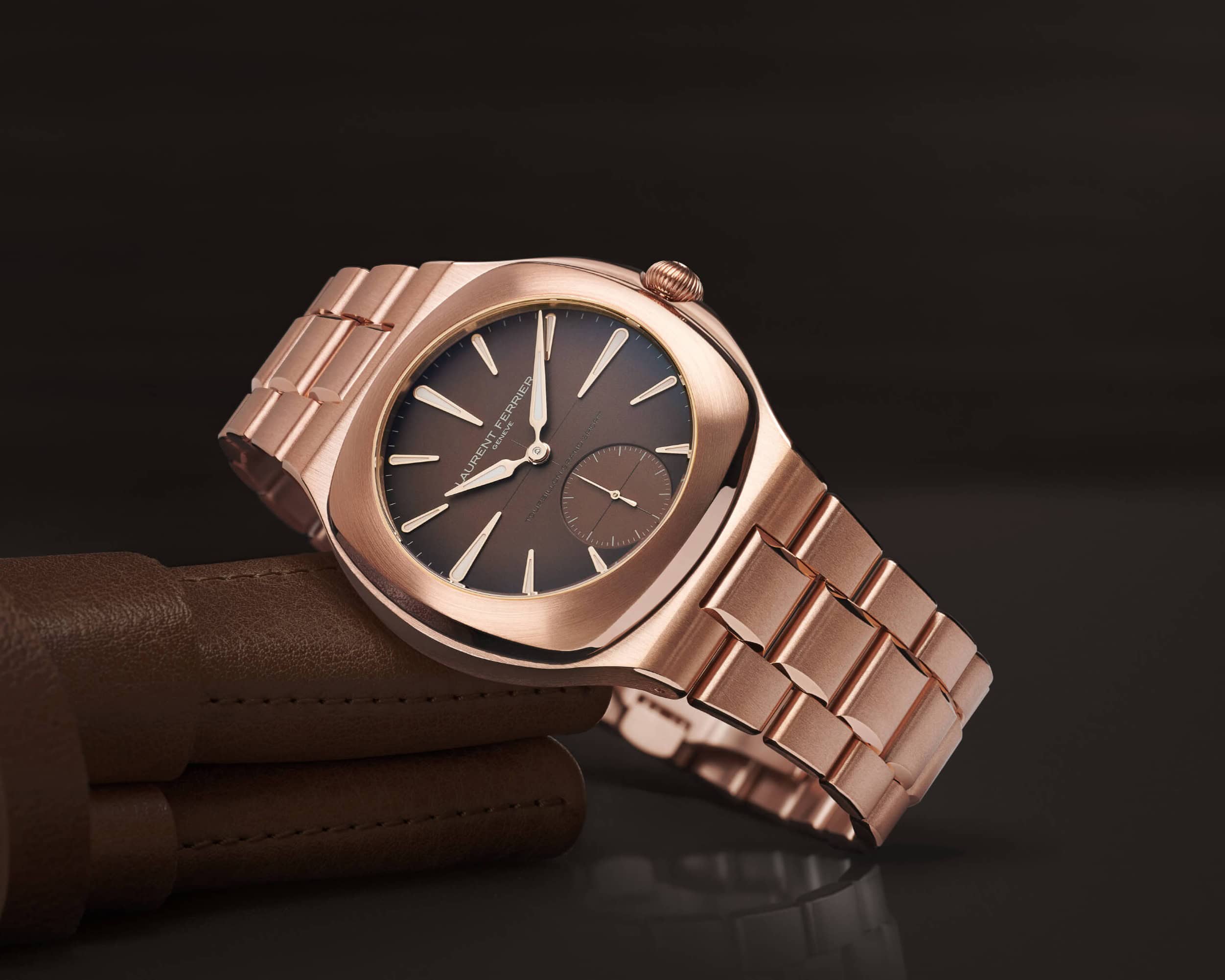
Even if integrated bracelet watches weren’t marketed so fervently, these elegant creations would have found their way into our hearts regardless.
Once a niche design, the integrated bracelet watch has evolved into a remarkably diverse category of timepieces.
Although it remains unclear who first conceived the integrated bracelet, the design emerged in the 1940s and 1950s largely on ladies’ watches. It wasn’t until the inimitable Gérald Genta designed the Audemars Piguet Royal Oak in 1972, and later the Patek Philippe Nautilus in 1976, that the integrated bracelet sports watch became a status symbol.

Backed by recent leaps in ergonomics, bracelet design and alternating finishing, this segment has swelled from an enthusiast niche into a dominant market force.
While the Royal Oak and Nautilus remain the undisputed “grails”, the landscape shifted dramatically in April 2025 when Rolex debuted the Land-Dweller, marking its official entry into this hotly contested battleground. Most notably, its hype wasn’t a fleeting trend; over a year since its release, the elusive Land-Dweller still commands lengthy authorized retailer waitlists and a staggering 70% premium on the secondary market.

Fortunately, the market has beautifully diversified across every price point, offering an intoxicating variety for watch enthusiasts who don’t have six-figure budgets.

Around US$1,000
A 1978 classic that was reintroduced in 2021, the Tissot PRX (retailing from around US$400) was a seismic game-changer. For collectors who find the Royal Oak out of reach, the PRX is a sleek alternative whose price point is lightyears from that of an entry-level Royal Oak. A PRX is by no means a signal of high net worth, but it’s a handsome and dependable watch, nonetheless, that Tissot sells millions of each year.
Maurice Lacroix reinterpreted its classic Calypso model as an integrated bracelet watch called the Aikon (from around US$1,500) in 2016 to compete in this category.

US$10,000 to 20,000
A jewelry brand steeped in horological history, Bulgari previously gave us hits like the Bulgari Roma (1975) and Bulgari Bulgari (1977). After Bulgari was acquired by LVMH in 2011, its emphatic revamp was lofted by the Octo Finissimo (from around US$14,000), which set 10 world records in ultra-thin watchmaking across 11 years, and secured Bulgari’s seat in the pantheon of 21st-century haute horlogerie.

Also flying the LVMH flag is the Zenith Defy (from around US$10,000), which comprises modern iterations like the Defy Skyline and Defy Revival. Interestingly, this collection traces its roots back to the Zenith Defy A3642 of 1969, pre-dating the Genta creations. The Skyline collection is driven by both Zenith’s in-house Elite calibers and by its legendary workhorse El Primero movement that powered early Rolex Daytona models.
An antimagnetic tool watch that IWC designed for STEM professionals, the IWC Ingenieur (from around US$11,000) didn’t arrive on an integrated bracelet when it debuted in 1955, but due to popular demand, the integrated bracelet gradually became a quintessential feature of the Ingenieur.
Fellow Richemont brand Piaget introduced the Piaget Polo (from around US$14,000) in 1979. An elegant icon distinguished by its flowing bracelet and gadroon-patterned horizontal ribs, it is now the maison’s flagbearer.

In 1977, Vacheron Constantin created one of the integrated bracelet segment’s most sought-after beauties: The 222. Although this vintage rarity now goes for an arm and a leg in the secondary market, the Vacheron Constantin’s Overseas (from around US$29,000 for the 41mm models) descends from the 222 and is a cornerstone of the brand’s modern-day offerings. Today, the Overseas collection spans a wide range of iterations that are meant to appeal to various genders and preferences.
Recognizing the undeniable popularity of its vintage dress watches, sister brand Jaeger-LeCoultre recently relaunched its Master collection (from around US$14,200) with time-and-date, bicompax with date and power reserve subdials, and perpetual calendar options, as well as a stunning new bracelet design.
Although the Cartier Santos and Santos-Dumont mostly retail in this price range, there are quartz-powered versions of the Santos-Dumont that can be had from US$4,800.

Independents
Having recently gained independence, Girard-Perregaux has been expanding the Laureato (from around US$15,000) family by introducing scintillating new renditions like the Girard-Perregaux Laureato Three Gold Bridges and Girard-Perregaux Laureato Fifty.
Among integrated bracelet fans, Czapek & Cie enjoys top-of-mind awareness, thanks to the spellbinding silhouettes of its Antarctique (from around CHF22,400) collection.
While Czapek unveiled a new pair of timepieces today—the Czapek Antarctique Frozen Meteor and Czapek Antarctique S Frozen Meteor that feature meteorite dials—Parmigiani Fleurier too welcomed a new rendition of its beloved Tonda PF, called the Parmigiani Fleurier Tonda PF Sport Chronograph Ultra-Cermet Morning Blue.

Some argue that the crown should go to the Parmigiani Fleurier Tonda PF (from around CHF22,000). With proportions that many collectors have described as ‘perfect’, the Tonda collection entices with mesmerizing skeletonization, the rattrapante function (that the brand revived a few years ago), as well as a new chronograph function that remains concealed until it is activated. For the models without subdials or openworking, their unique selling point is grain d’orge—a unique style of engine-turning that has become Parmigiani Fleurier’s calling card.

Also manufactured in the Fleurier region, Scheufele family-owned Chopard proffers the Alpine Eagle (from around US$13,000), a 2019 reinterpretation of the Chopard St. Moritz. The latter was designed and launched in 1980 by Chopard co-president Karl-Friedrich Scheufele.
Last but not least, the Laurent Ferrier Sport Auto commands a cool CHF46,000 minimum, as it is infused with the immense savoir-faire and unassailable craftsmanship of its namesake master watchmaker, who cut his teeth in Patek Philippe for 37 years.
