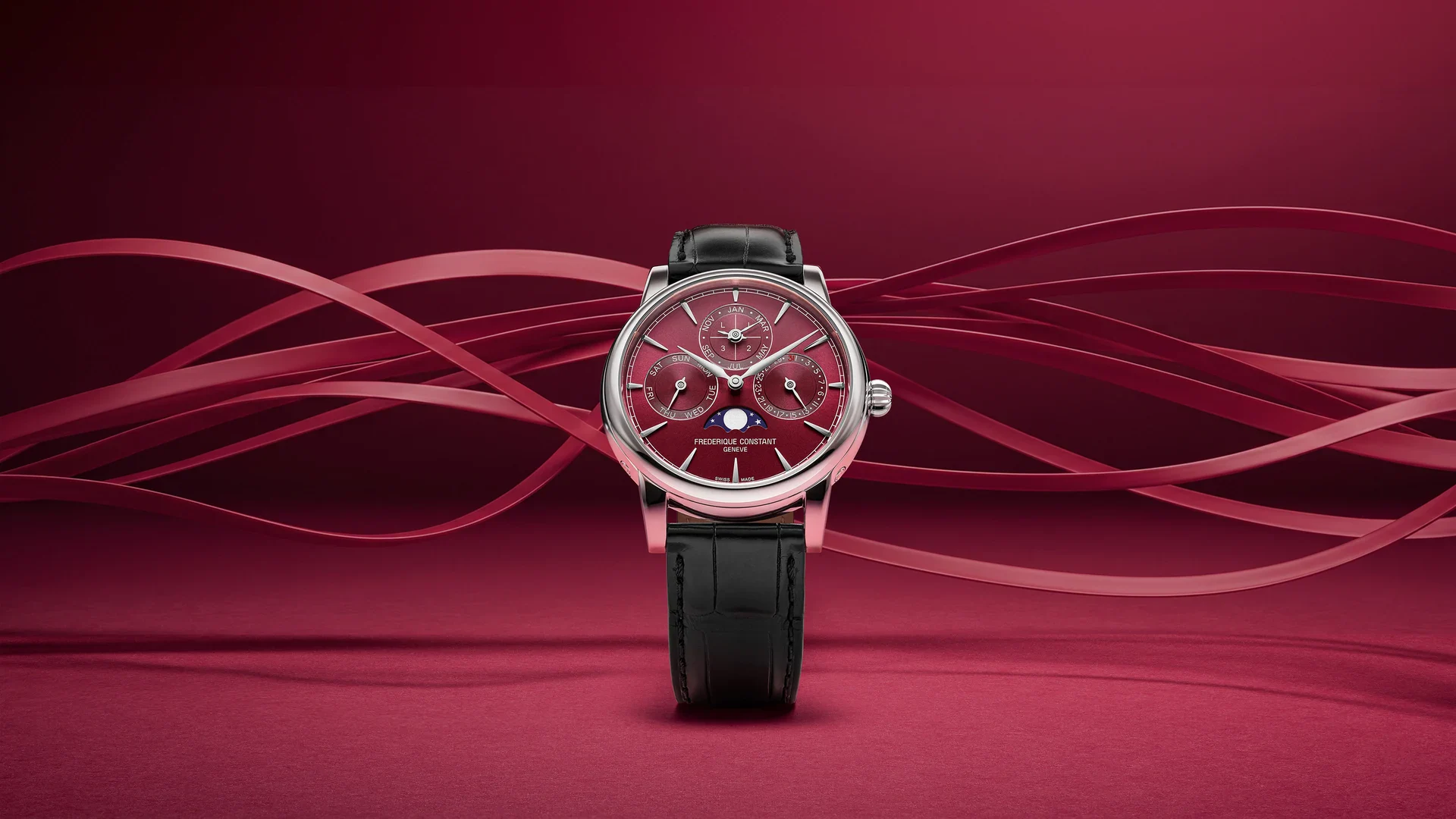
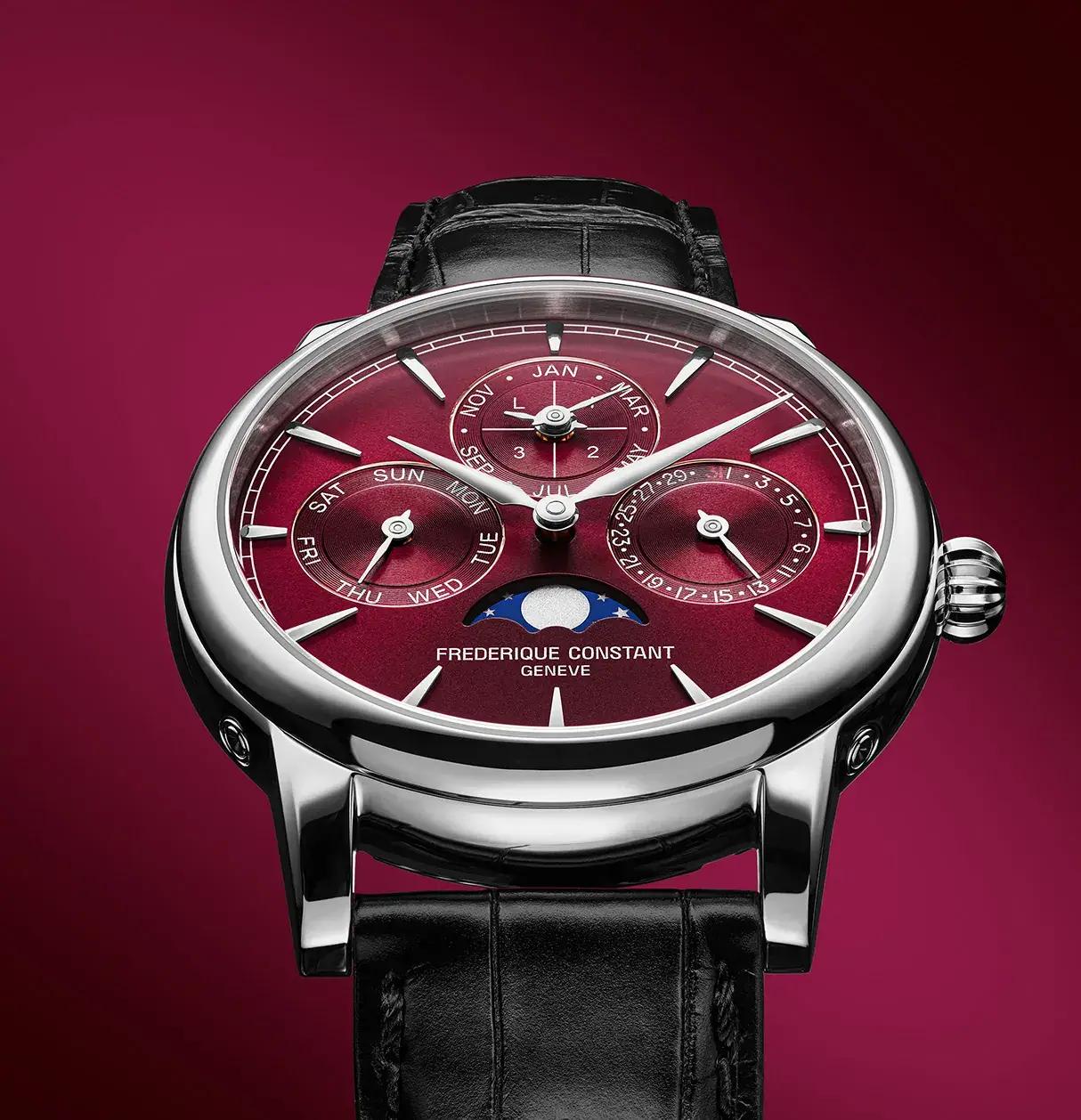
A perpetual calendar watch knows that April has 30 days, that August has 31, and that February has 28 days, or 29 in a leap year. It keeps all of that straight without help until 2100. The newest example is Frederique Constant’s Classic Perpetual Calendar Manufacture FC-776BRG3H6, a 100-piece limited edition with a sunray-brushed burgundy dial, the first time the brand has put that color on this watch.
A perpetual calendar watch tracks 30- and 31-day months and leap years on its own, usually with a program wheel that turns once every four years, and needs no date correction until 2100. Frederique Constant's new FC-776BRG3H6, limited to 100 pieces, puts one in a 40mm steel case.
The trouble starts with the calendar, which is irregular by design. Seven months have 31 days, four have 30, and February has 28 or 29. Leap years come every four years, with one more rule layered on top: century years are leap years only if they divide evenly by 400. That is why 2000 had a February 29 and 2100 won’t. A simple date wheel with 31 positions gets this wrong five times a year, every time a shorter month ends, and needs a nudge from its owner each time.
How a Perpetual Calendar Watch Keeps Count
A perpetual calendar answers with mechanical memory. The classic version is a program wheel that turns once every four years and carries 48 notches, one for each month in a four-year cycle. The notches are cut to different depths: shallow for 31-day months, deeper for 30-day months, deeper still for February, with one February notch shallower than the other three so the watch allows a 29th day in the leap year.
At the end of each month, a lever drops onto the wheel, and how far it falls tells the mechanism how many days to skip, so on the night of February 28 in a common year, the date jumps straight to the 1st.
Some movements split that job, using a 12-month cam that turns once a year with a separate leap-year wheel that turns once every four. Either way, the date, day, month, and leap-year cycle advance on their own, and the owner’s only job is to keep the watch running.
Frederique Constant’s version shows the day at 9 o’clock, the date at 3 o’clock, the month and the leap-year cycle together at 12 o’clock, and a moon phase at 6 o’clock against a night-blue sky with laser-engraved stars.
That self-sufficiency has a catch. If a perpetual calendar stops, it has to be brought back to the right date, usually with small recessed correctors on the case side, pressed with a stylus, to advance each indication. Most makers also warn against using those correctors in the hours around midnight, when the calendar mechanism is engaged, so the manual is worth reading before the first reset.
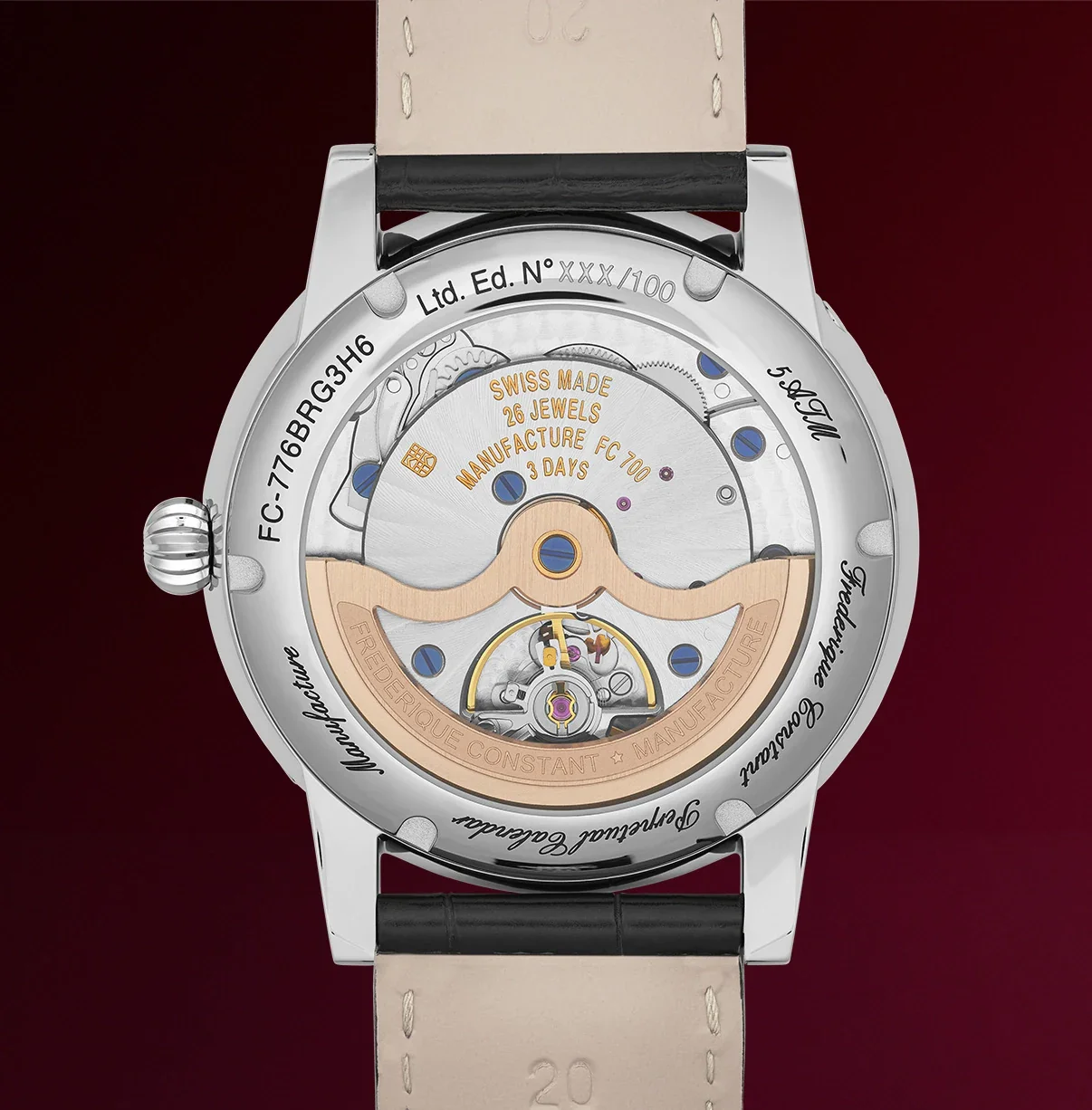
A long power reserve helps here, and the FC-776’s 72 hours means the watch can sit off the wrist for a weekend and still be on the right date on Monday.
The FC-776 is Frederique Constant’s own calibre, an automatic movement that beats at 28,800 vibrations per hour (4 Hz) and evolved from the original FC-775 with a redesigned mainspring barrel and a new alloy spring. In this edition, it sits in a 40mm polished steel case that is 12.25mm thick, with a sapphire caseback and 50 meters of water resistance. Each of the 100 pieces carries its own number on the case.
Frederique Constant lists the watch as “coming soon” and has not published a price; on its own site, other Classic Perpetual Calendar Manufacture references, such as the FC-776N3H6, are listed at CHF 9,995.
Annual, Full and Secular Calendars
The perpetual sits near the top of a ladder. A full calendar, sometimes called a triple calendar, shows the day, date, and month but assumes every month has 31 days, so it needs correcting five times a year. An annual calendar knows the difference between 30- and 31-day months and needs correcting only once, at the end of February. The perpetual handles February too, including leap years.
A secular perpetual calendar goes one step further and accounts for the 400-year rule, so it knows that 2100, 2200, and 2300 are not leap years. Every other perpetual calendar needs one correction this century, in 2100, when it will show a February 29 that doesn’t exist.
The competition now is over thickness. In our view, the most impressive perpetual calendars today are the slimmest, not the busiest. Vacheron Constantin fit a full perpetual calendar into a movement just 4.05mm thick for its Overseas Perpetual Calendar Ultra-Thin Azure Dial, and Bulgari’s Octo Finissimo Perpetual Calendar set a thinness record when it arrived in 2021.
If this is your first close look at a complication, our explainer series continues with the tourbillon and the remontoir d’égalité, and our guide to the five complications every collector should understand puts all of them in context. Of all of them, the perpetual calendar is the one you live with most directly: a mechanical copy of the Gregorian rules, counting toward 2100 on your wrist.
| Specification | Detail |
|---|---|
| Reference | FC-776BRG3H6 |
| Edition | 100 individually numbered pieces |
| Case | Polished stainless steel, 40mm, 12.25mm thick, sapphire crystal and caseback |
| Water resistance | 5 ATM |
| Dial | Burgundy, sunray-brushed, with railway minute track and applied faceted indexes |
| Functions | Hours, minutes, day, date, month, leap year, moon phase |
| Movement | FC-776 manufacture calibre, automatic, 28,800 vph, 26 jewels |
| Power reserve | 72 hours |
| Strap | Black alligator leather, folding buckle |
Timely FAQs
What is a perpetual calendar watch?
What is the difference between an annual calendar and a perpetual calendar?
How many Frederique Constant FC-776BRG3H6 watches will be made?
Does a perpetual calendar watch ever need correcting?
