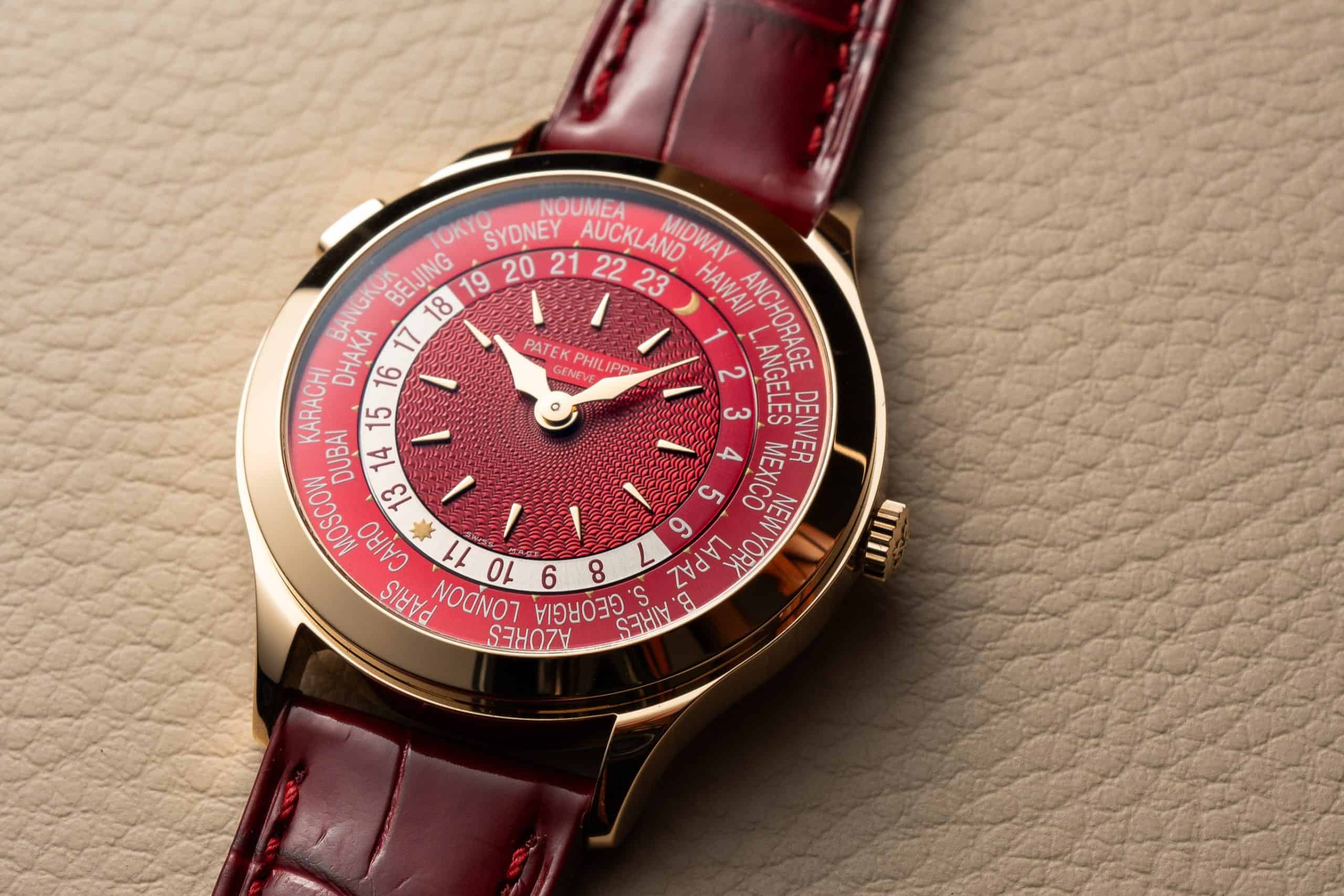
There are few watches that make the world feel quite so small as a Patek Philippe World Time.
The Patek Philippe World Time is a watch complication invented by Geneva watchmaker Louis Cottier in the 1930s, displaying the time in all 24 global time zones simultaneously through a rotating city ring and 24-hour disc.
At first glance, it seems almost deceptively simple. A pair of elegant hands tells the local time, while a ring of cities circles the dial and another ring of numbers tells you the hour everywhere else. Geneva, London, New York, Sydney, Tokyo, and the rest of the world’s great cities are compressed into a single 36mm or 40mm disc of precious metal.
Beneath that seemingly effortless display, however, lies one of the most ingenious mechanisms in watchmaking history, and one that has been intertwined with Patek Philippe for nearly a century.
The World Time was born in an era when traveling from one continent to another was still a rare adventure rather than routine. Its creator, the Geneva watchmaker Louis Cottier, developed the mechanism in the 1930s, when the arrival of transatlantic aviation and international telecommunications was beginning to shrink global boundaries. Patek Philippe quickly recognized its potential, and the manufacture’s World Time watches would eventually become among the most recognizable and coveted creations in its history.
And perhaps that is why the World Time remains such a quintessentially Patek Philippe complication. It is not merely technically clever. It turns geography into engineering, practicality into decoration, and the entire planet into a watch dial.
The Man Who Put the Earth on a Dial
Born in Geneva in 1894, Cottier was the son of a master watchmaker and an independent genius whose specialty was solving extraordinarily complex problems in remarkably elegant ways. Working out of his modest workshop in Carouge, Cottier took the planet’s 24-hour cycle and translated it into something that could be intelligible at a single glance.
The principle is wonderfully simple: A fixed outer ring carries the names of 24 representative cities, each standing for one of the world’s time zones. Inside it sits a 24-hour rotating ring, divided visually between light and dark hours to signify day and night. Once the wearer sets the city corresponding to their current location at 12 o’clock, the two rings reveal the local time in every other zone simultaneously.
In other words, rather than adding another hour hand to tell you the time somewhere else, Cottier essentially made the entire dial into a dynamic map, and soon a canvas, of time.
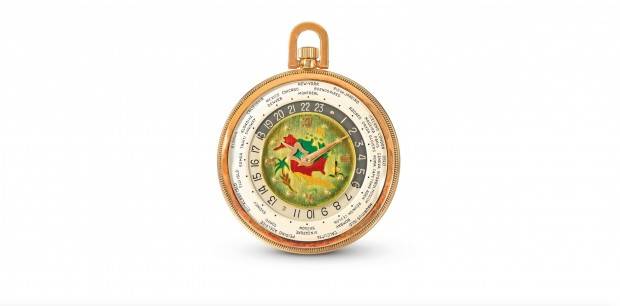
Patek Philippe was among the earliest and most important clients for Cottier’s invention. The manufacture’s first World Time wristwatches appeared in the late 1930s, most famously in the Ref. 1415. Introduced around 1939, the Ref. 1415 featured a hand-engraved rotating bezel carrying the city names, an aesthetic hallmark that felt almost instrument-like on the wrist.
The timing was perfect. The 1930s were witnessing an extraordinary expansion in commercial aviation, and the World Time was a complication genuinely suited to the newly globalized world.
The Ref. 2523 Changes Everything
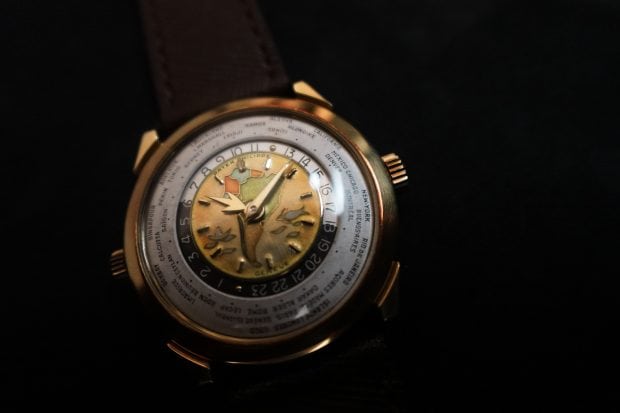
If the Ref. 1415 proclaimed the World Time, the Ref. 2523 turned it into a sought-after icon. Introduced in 1953, the 2523 replaced the hand-rotated bezel with Cottier’s dual-crown architecture. One crown at 3 o’clock wound and set the watch, while a second crown at 9 o’clock controlled the city disc. It was a vastly more sophisticated and visually distinctive interpretation of the concept, housed in a bolder, angular case measuring roughly 36mm—a substantial size for the era.
The real magic though, occurred in the middle of the dial. Patek Philippe began pairing Cottier’s mechanism with elaborate decorative centers, including hand-guilloché patterns and, most famously, cloisonné enamel maps depicting continents and oceans. Suddenly, the watch was performing two roles simultaneously: the outer rings executed an ingenious piece of mechanical information design, while the center transformed into a miniature work of fine art. This pairing would become central (don’t mind the pun) to the identity of the Patek World Time.
The map was not simply decorative, but the ultimate visual metaphor for the complication. Here was the whole world rendered on a watch, its continents reduced to tiny islands of vibrant enamel and its political divisions represented by nothing more than the rotating architecture of the dial.
The finest vintage examples of the 2523 remain among the most desirable watches on earth. Their legendary status is driven by extreme scarcity: it is estimated that fewer than 40 total pieces of the original 2523 were ever cased, followed by a similarly tiny run of the 2523/1. This rarity came to a head at auction when a 1953 Ref. 2523 “South America” (pictured above) fetched a record-shattering $10.2 million in May 2026, cementing it as one of the most valuable vintage wristwatches in horological history. And then, remarkably, the World Time disappeared.
Into Thin Air
Patek Philippe stopped producing its vintage World Time wristwatches during the mid-1960s. Following Louis Cottier’s death in 1966, the complication vanished from the manufacture’s catalog for more than three decades.
That hiatus might have killed lesser watches. Instead, it made the surviving pieces legendary.
As vintage Patek Philippe collecting transformed into a serious international pursuit, the early Refs. 1415s and 2523s acquired an almost mythical status. Their combination of extreme rarity, historical weight, and decorative craftsmanship made them the Holy Grail for serious collectors.
By the end of the 20th century, Patek Philippe recognized that the world was ready for its travel icon to return.
The World Time Returns
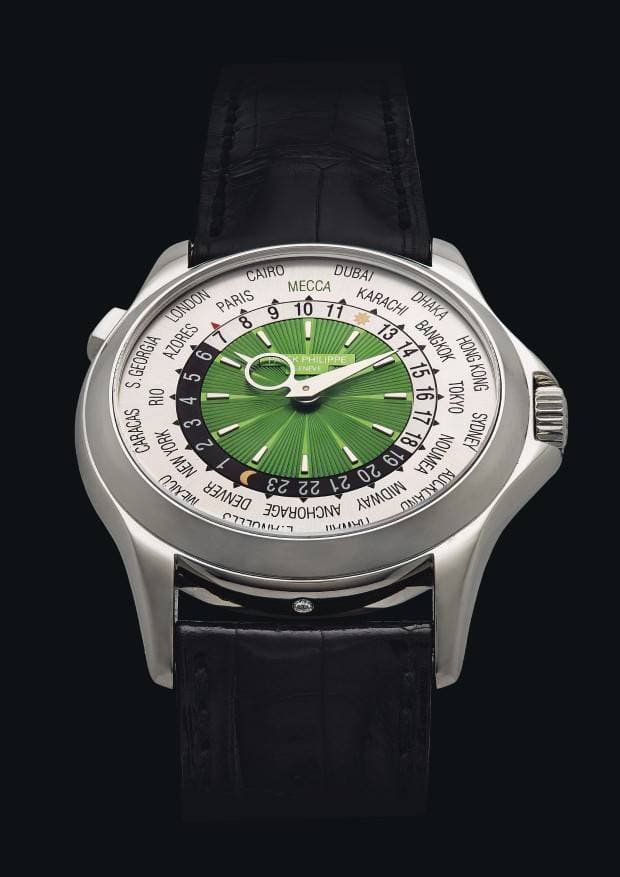
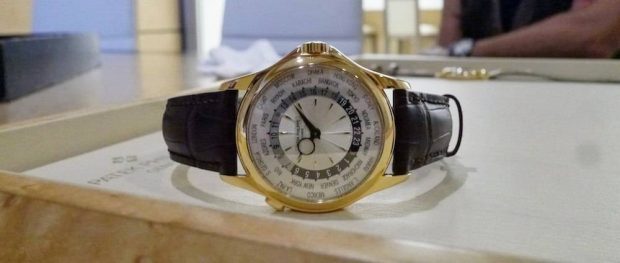
In the year 2000, Patek Philippe resurrected the complication with the Ref. 5110. It was a thoroughly modern interpretation of Cottier’s original concept. Rather than the two-crown architecture of the 2523, the 5110 featured a single, intuitive pusher at 10 o’clock. With a single click, the wearer could jump the hour hand forward while simultaneously advancing the city ring and 24-hour disc—a triumph of user-friendly mechanical engineering.
Under the dial beat the self-winding Calibre 240 HU, built around Patek’s iconic 22k gold micro-rotor. This allowed the movement to remain exceptionally slim despite the complexity of the display.
The mechanism had also been refined through modern innovation. A patent granted to Patek Philippe in 1999 allowed the World Time mechanism to completely uncouple from the gear train during city switching. Consequently, pressing the pusher to jump time zones would not disrupt the movement’s amplitude or the precise progression of the minute hand.
It is this precise detail that explains why the World Time is so satisfying to operate. The complication appears effortless because the engineering beneath it has shouldered the burden.
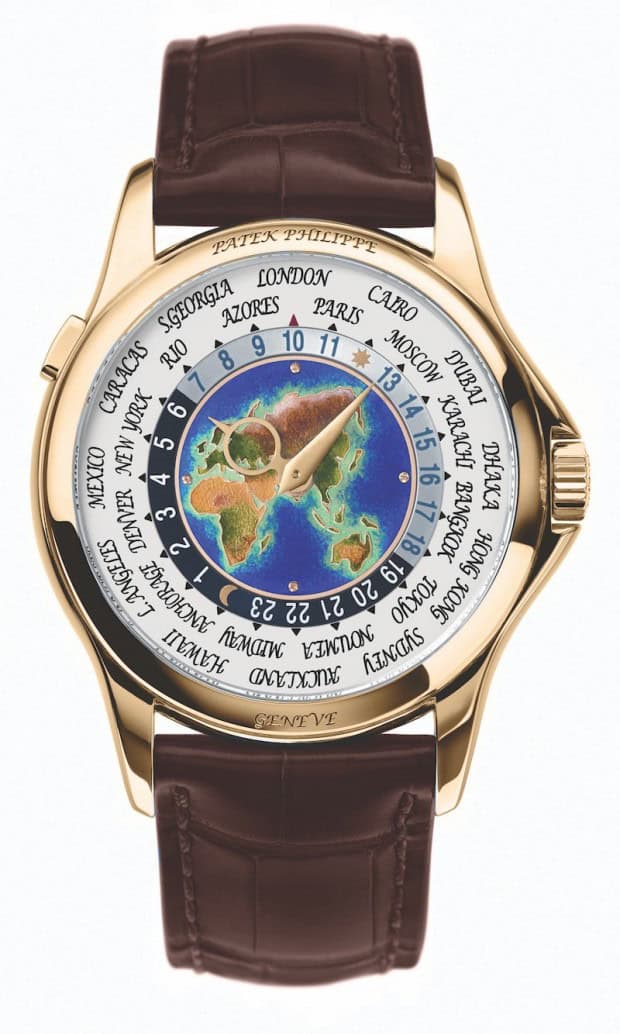
The Ref. 5110 was an instant success, setting the stage for the complication’s modern evolution: The Ref. 5130 (2006) expanded the case to 39.5mm and reintroduced the nostalgic “ringed” hour hand inspired by the vintage Ref. 1415, while the Ref. 5131 (2008) brought back the sacred art of the Grand Feu cloisonné enamel dial to the modern catalog, creating years-long waiting lists.
From Engineering Feat to a Laborious Work of Art
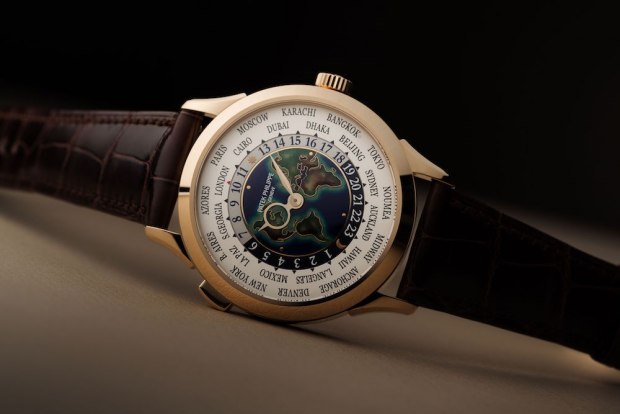
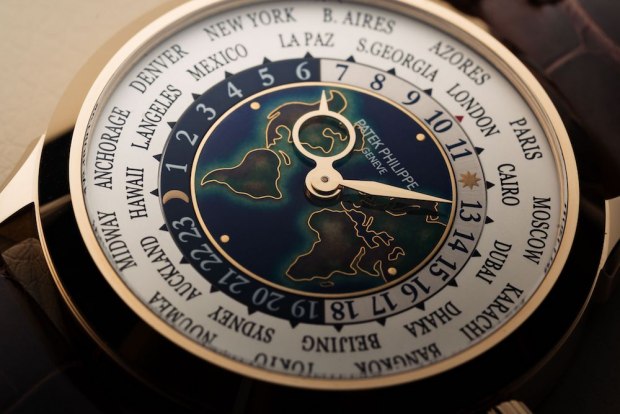
The Ref. 5131 best demonstrates why Patek Philippe’s World Time is so much more than a functional travel accessory. To create its dial, a master enamel artisan outlines tiny continental landmasses using fine strands of gold wire—thinner than a human hair—before filling the compartments (cloisons) with silica-based enamel pigments. The dial is then fired in an oven at temperatures exceeding 800°C (this is considered Grand Feu, as it translates to “Big Fire”) multiple times. As the process is fraught with risks of cracking or bubbling, no two dials are ever identical. A complication concerned with global geography becomes a physical canvas for depicting it.
The 5131 series also celebrates regional diversity across its iterations: yellow gold (5131J) showcases the Americas, Europe, and Africa; white gold (5131G) focuses on Europe, Africa, and Asia; and platinum (5131P) renderes a dramatic view of the North Pole.
Collectors were no longer just choosing precious metals, but choosing which perspective of Earth best represented them.
Keeping Up with a Changing World
In 2016, Patek Philippe retired the Ref. 5130 to introduce the Ref. 5230. The primary driver for the update was practical: the world itself had changed.
Time zones are political constructs, and over time, global geopolitical shifts necessitated an update to the city ring. Moscow, for example, had shifted its standard time from UTC+4 to UTC+3; other nations altered Daylight Saving policies or changed primary reference cities.
Patek used the update to introduce winglet-style lugs, delicate hands inspired by vintage pocket watches, and a dial center featuring an intricate hand-guilloché pattern crafted on historical rose engines in their Geneva manufacture.
One of the World Time’s greatest charms, the Ref. 5230’s updated design is dynamically dictated by the real world.

Combining Complications: The World Time Chronograph
Having perfected the standalone World Time, Patek Philippe set its sights on uniting it with another signature complication: the chronograph.
In 2016, Patek introduced the Ref. 5930, combining a World Time mechanism with an automatic flyback chronograph. The watch was inspired by a pièce unique vintage Patek Philippe World Time chronograph from 1940 (Ref. 1415-1), transforming an obscure historical experiment into a modern masterpiece.
The execution was a marvel of information design. Inside the dial, a central chronograph seconds hand and a 30-minute counter operate seamlessly alongside the rotating 24-hour ring and outer city ring. Driven by the Calibre CH 28-520 HU, it proved that even two wildly complex features could coexist in harmony.
Whether rendered in white gold with a blue dial or in platinum with a vibrant emerald-green hand-guilloché center, it represents the World Time at its most sporty and expressive.

The Final Frontier: A Date That Knows Where You Are
For all its ingenuity, the World Time retained one long-standing mechanical limitation: adding a date display that automatically adjusts backward or forward as you cross the International Date Line was notoriously difficult. That changed with the Ref. 5330G.
Debuted at the Watch Art Grand Exhibition in Tokyo in 2023 before joining the regular catalog in 2024, the 5330G introduced a world-first complication: a local-time date display.
Powered by the Calibre 240 HU C, the watch features a patented central date hand made of transparent glass with a red hammer-shaped tip. Driven by a complex differential system, the date hand automatically steps forward—or backward—whenever the wearer adjusts the local city setting at 12 o’clock across midnight boundaries.
It was an extraordinarily complex answer to a fundamental travel problem, and a testament to Patek Philippe’s relentless pursuit of functional perfection.
A World That Fits on the Wrist
Today, Patek Philippe’s World Time family offers a fascinating spectrum of horological personalities:
The Ref. 5231G features Grand Feu cloisonné enamel centers depicting Oceania and Southeast Asia; the Ref. 5330G is equipped with the revolutionary local-time date system; the Ref. 5930P fuses a flyback chronograph with universal time in platinum; and the recently launched 36mm yellow gold Ref. 7129J brandishes a striking carmine-red dial, showing that the World Time can be as fashion-forward as it is technically sound.
Underneath every variation sits the soul of Louis Cottier’s original vision, but now with the press of a single pusher, you jump seamlessly between time zones. The 24-hour disc tells you whether the sun is rising in London or setting in Tokyo, while the main hands anchor you to where you stand right now.

The Most “Patek” of Complications?
When horophiles discuss Patek Philippe, conversation often turns to perpetual calendars or minute repeaters. Both are monumental achievements with deep historical roots within the brand. Yet there is something uniquely romantic about the World Time.
It embodies everything that makes Patek Philippe extraordinary: mechanical complexity concealed behind effortless usability, classical case architecture, decorative mastery, and an enduring respect for history.
More than anything, it tells the story of human progress. Louis Cottier designed the mechanism when crossing an ocean required days on a steamship. Patek Philippe perfected it during the dawn of commercial flight, nurtured it through the jet age, and continues to refine it in an interconnected, digital world.
On a Patek Philippe World Time, the world is not merely something you travel across. It is something you carry with you.