There is a moment in every enameler’s day when the work leaves their hands entirely. The dial goes into the kiln, the door closes, and for a few minutes a month of patient labor is at the mercy of heat. Sometimes the colors come out exactly as imagined. Sometimes a crack runs through them and the piece starts again from nothing. It is the least efficient way imaginable to make a watch dial, and that is precisely why collectors care.
Métiers d'art watches use decorative crafts such as enamel, porcelain painting, lacquer, engraving and hand-skeletonizing. Fall 2026 highlights include Patek Philippe's cloisonné Ref. 5531G Milan editions and Glashütte Original's Senator Meissen "Cherry Blossom" with a hand-painted porcelain dial.
This fall, those crafts are having a moment. Patek Philippe built an entire room of its Watch Art Grand Exhibition in Milan around them, Glashütte Original turned to Saxony’s most famous porcelain manufactory for a new dial, and the Grand Prix d’Horlogerie de Genève will crown an Artistic Crafts winner in November. Together, the season’s métiers d’art watches make a persuasive argument that the most modern thing a watch can do is be made slowly.

Patek Philippe’s Cloisonné Milan
Patek Philippe’s Watch Art Grand Exhibition runs through Sunday, October 18, at Milan’s CityOval, the former Palazzo delle Scintille, with free admission and reservations recommended. Among the exhibition’s rooms is one devoted to Rare Handcrafts, where artisans demonstrate their techniques in person, and where the Manufacture is unveiling a collection of pieces whose themes are drawn from Italian culture.
The two watches that carry the city itself are the World Time Minute Repeaters Ref. 5531G-012 and Ref. 5531G-013, each issued in a limited edition of five. Their cloisonné grand feu enamel dials depict downtown Milan, by day on the 012 and by night on the 013. For the daytime version, Patek specifies 45cm of gold wire, about 0.15 grams, and a palette of 16 enamel colors, with “Milano” highlighted in red on a city disk written in Italian. We covered the full set of Milan limited editions when they launched, but the enamel deserves a second look.

Patek describes the technique with the precision of a recipe. Cloisonné, it explains, “uses flattened gold ‘ribbons’, or wires. They are soldered to the base metal of the object on their edges, fashioned into compartments, or cloisons, of a pattern that are then filled with enamel powders of various colors. In firing ovens, the powders melt and fuse.” The Manufacture adds that a single piece “can take several months, involve over twenty enamel colors and require several firings.” (For a primer on the firing itself, see our guide to grand feu enamel.)
The craft around the dial matches it. Each 5531G has a 40.2mm white gold case whose skeletonized lugs reveal a hand-guilloched hobnail pattern on the caseband, and the self-winding R 27 HU caliber is, per Patek, the first minute repeater that always strikes the local time of the zone shown at 12 o’clock. In our view, that is what lifts these above souvenir pieces: the enamel shows you the city, and the chime tells you what time it is there.
The room’s other headliners are just as Italian. The “Burano” pocket watch, Ref. 992/193J-001, renders the Venetian island’s colored houses and canals in cloisonné enamel in some 70 colors, with paillonné gold and silver leaf catching the light on the water, while the “Sicilian Oranges” Dome Clock, Ref. 20179M-001, sets an orange grove in cloisonné against a miniature-painted view of Palermo.

Porcelain, Lacquer and Stone
If enamel is glass fused to metal, porcelain is its more fragile cousin, and Glashütte Original’s new Senator Meissen “Cherry Blossom” shows why so few brands try it. The dial is made in the MEISSEN workshops in the Saxon town of Meissen, home to Europe’s first porcelain manufactory, and it is only 0.8mm thick, which the brand calls “extremely challenging” to produce. Painters work from closely guarded formulas developed in MEISSEN’s in-house color laboratory, applying white and pink blossoms with fine brushes, and the dial is fired layer by layer at 900°C to build the depth of color.
The rest of the watch is quietly excellent. A flat 40mm red gold case frames the dial and solid gold hour and minute hands, and inside is the automatic Calibre 36 with a 100-hour power reserve, 28,800 vibrations per hour and a silicon balance spring. It is one of Glashütte Original’s atelier commissions, each assembled and regulated by a single watchmaker, and it pairs two Saxon manufactories that have been perfecting their crafts for centuries.
The GPHG’s Artistic Crafts category, which the competition defines as watches “demonstrating exceptional mastery of one or several artistic techniques such as enamelling, lacquering, engraving, guilloché (engine-turning), marquetry, skeleton-working,” offers the season’s widest survey. Louis Vuitton’s Tambour Taiko Arty Automata, one of the six finalists, uses 23 shades of champlevé enamel across a dial that took more than 250 hours of handwork, with a rotor in miniature painting. Bvlgari’s Serpenti Misteriosi, in the same category, revives a 1960s heritage design in five shades of lacquer, hiding the tiny BVL 100 Piccolissimo movement in the serpent’s head.
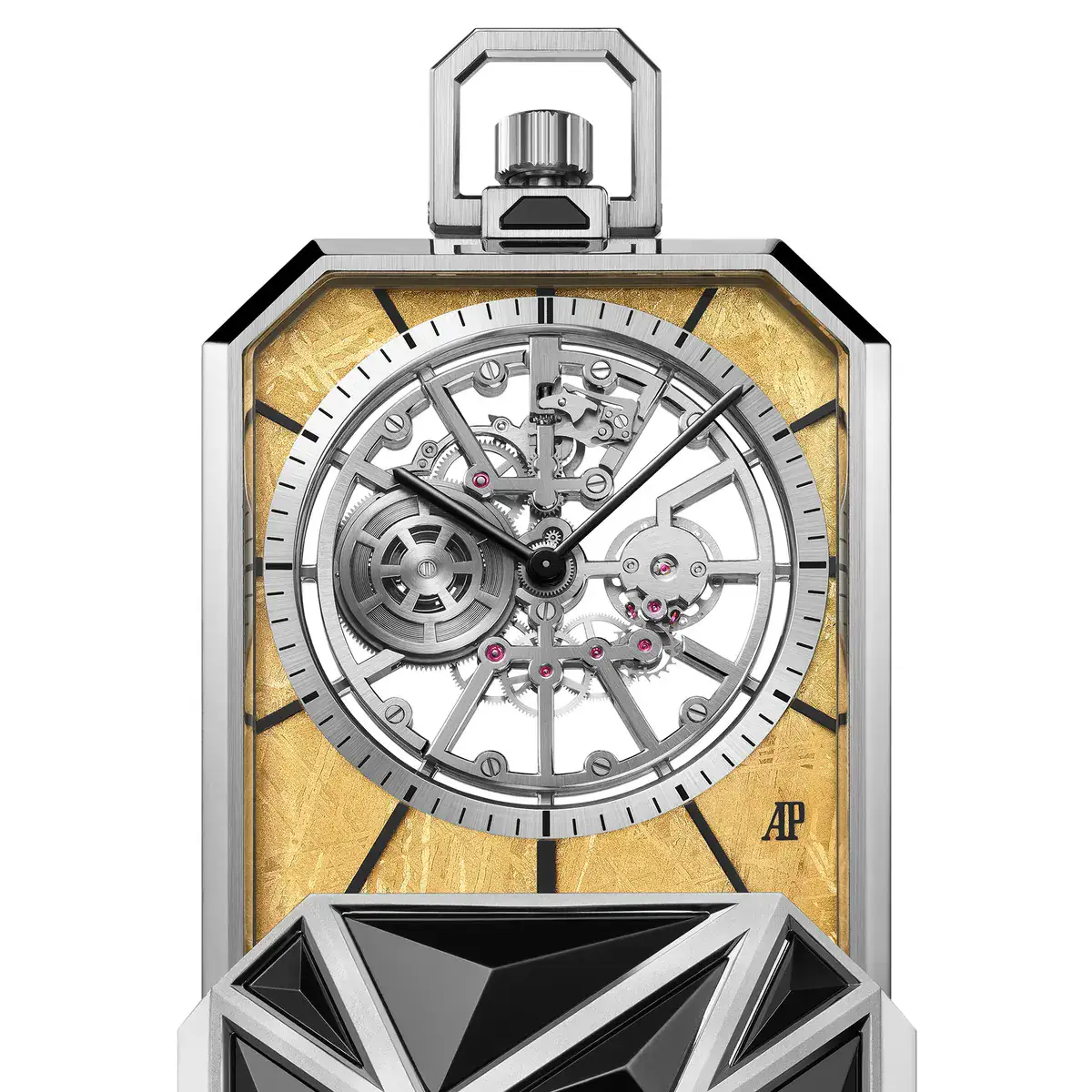
Audemars Piguet’s Établisseurs Nomade, another finalist, takes the idea in a different direction. Its outer dial is cut from meteorite, its titanium case is set with faceted black onyx, and its Calibre 7501 is skeletonized by hand with a hacksaw, a skill Audemars Piguet says it has preserved since the 1930s. The finalists are on show at Geneva’s Musée d’Art et d’Histoire before the GPHG ceremony on November 7.
Not every artistic watch needs a kiln, of course. Zenith’s DEFY Chronograph USM TimeForArt unique piece turned its dial into a mirror for charity, and for collectors whose idea of craft is acoustic rather than visual, Jacob & Co.’s new Palatial minute repeater makes its case in sound. And for those who prefer their enamel with history, Phillips’ Geneva sale on November 7 and 8 includes a 1950 Patek Philippe World Time Ref. 605HU with a cloisonné “North America” dial, its enamel disc bearing the “LC” monogram of Louis Cottier, inventor of the world-time system.
That lineage is the point. The cloisonné map on a 1950 pocket watch and the cloisonné Milan on a 2026 minute repeater were made the same way, by hand, one firing at a time. Fashions in watchmaking come and go, but the kiln is still the kiln.
Timely FAQs
What are métiers d'art watches?
What is cloisonné enamel on a watch dial?
How many Patek Philippe 5531G Milan watches were made?
What is the dial of the Glashütte Original Senator Meissen made of?
