URWERK has never treated watchmaking as a simple exercise in telling the time, and the new UR 1001 Amadeus pushes that philosophy into extraordinary territory. Unveiled in Geneva on August 25, 2026, the one of a kind pocket watch brings together radical Swiss mechanical engineering, elaborate hand engraving and an unusual interpretation of time that stretches from seconds and minutes to years, centuries and an entire millennium. Created as part of URWERK’s Special Projects collection, the Amadeus is designed to make the passage of time feel tangible, expansive and almost philosophical.
URWERK’s UR 1001 Amadeus turns time into art, combining daring mechanics, hand engraved titanium and a millennium scale in one extraordinary creation.
The URWERK UR 1001 Amadeus carries a price of CHF 450,000, approximately $561,000, reflecting its unique status, highly complex movement and extensive artisanal work. Rather than positioning the piece as another conventional luxury watch, URWERK has created an object that sits somewhere between haute horlogerie, mechanical sculpture and contemporary art.
The concept behind the UR 1001 began with an unusual design challenge. URWERK co founder Martin Frei had been exploring how the brand could extend its signature satellite display architecture beyond hours and minutes to include days and months. When the proposed satellite carousels collided during development, the wristwatch concept reached a dead end because there was simply not enough room. That limitation eventually led to the creation of a pocket watch, giving URWERK the space to build a much larger and more ambitious mechanical system.
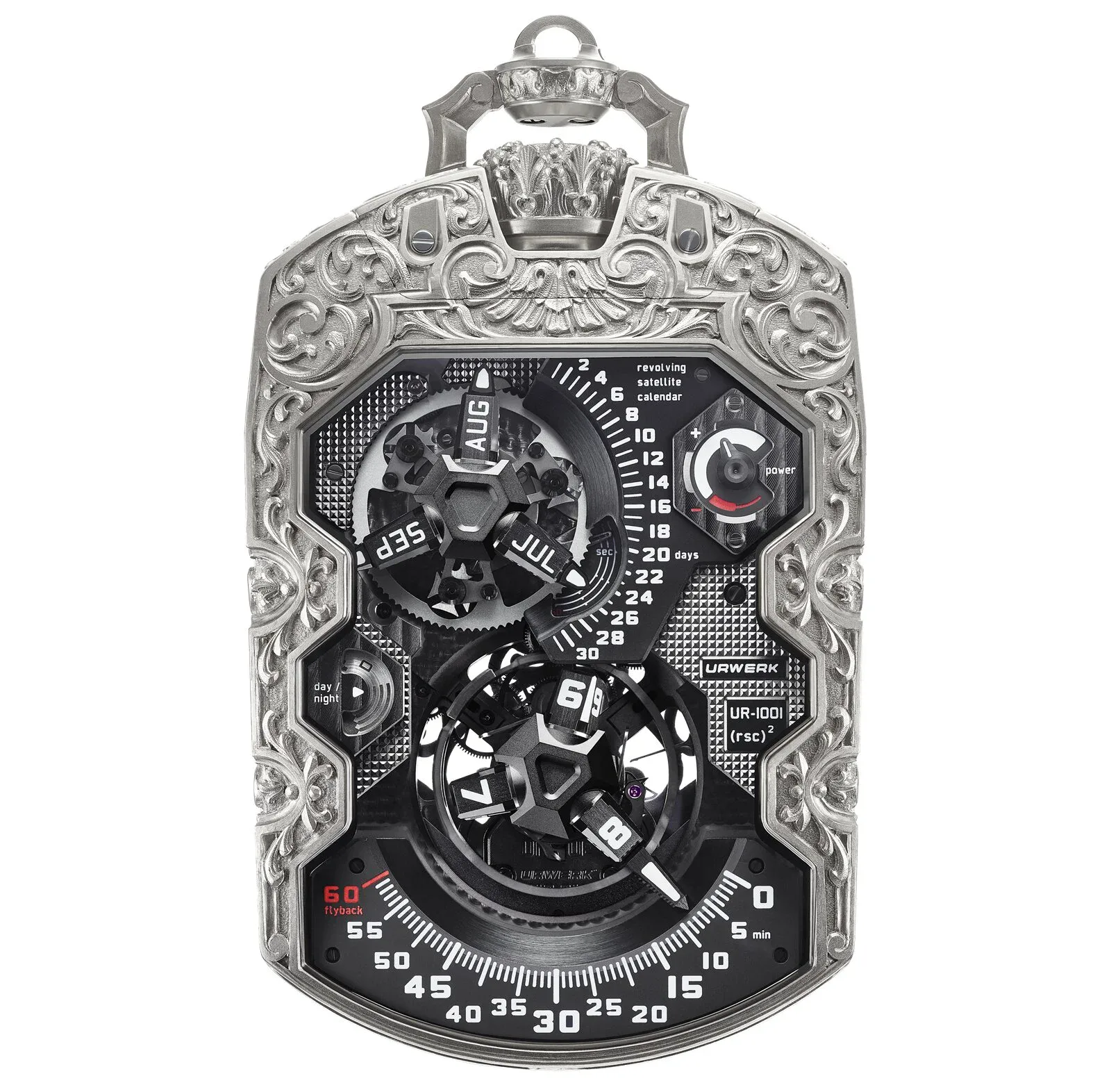
On the front, the flying satellite hours display sits at 6 o’clock and appears almost suspended above the movement. With no upper bridge covering the mechanism, the wearer receives an unobstructed view of the satellite system and its retrograde minutes display. At 12 o’clock, three orbital arms rotate through an annual calendar, automatically accounting for months containing 28, 30 or 31 days. Instead of hiding the calendar behind a conventional aperture, URWERK makes the mechanism itself part of the visual experience.
The dial also features a hand painted day and night display at 9 o’clock, combining a black Super LumiNova treated night sky with a finely brushed white ruthenium plated surface representing daylight. Delicate transitional lines depict dawn and dusk, while a dedicated indicator displays the watch’s 39 hour power reserve. The seconds are represented through three hands showing three 20 second segments across a 120 degree sector, giving even the smallest measurement of time its own mechanical expression.
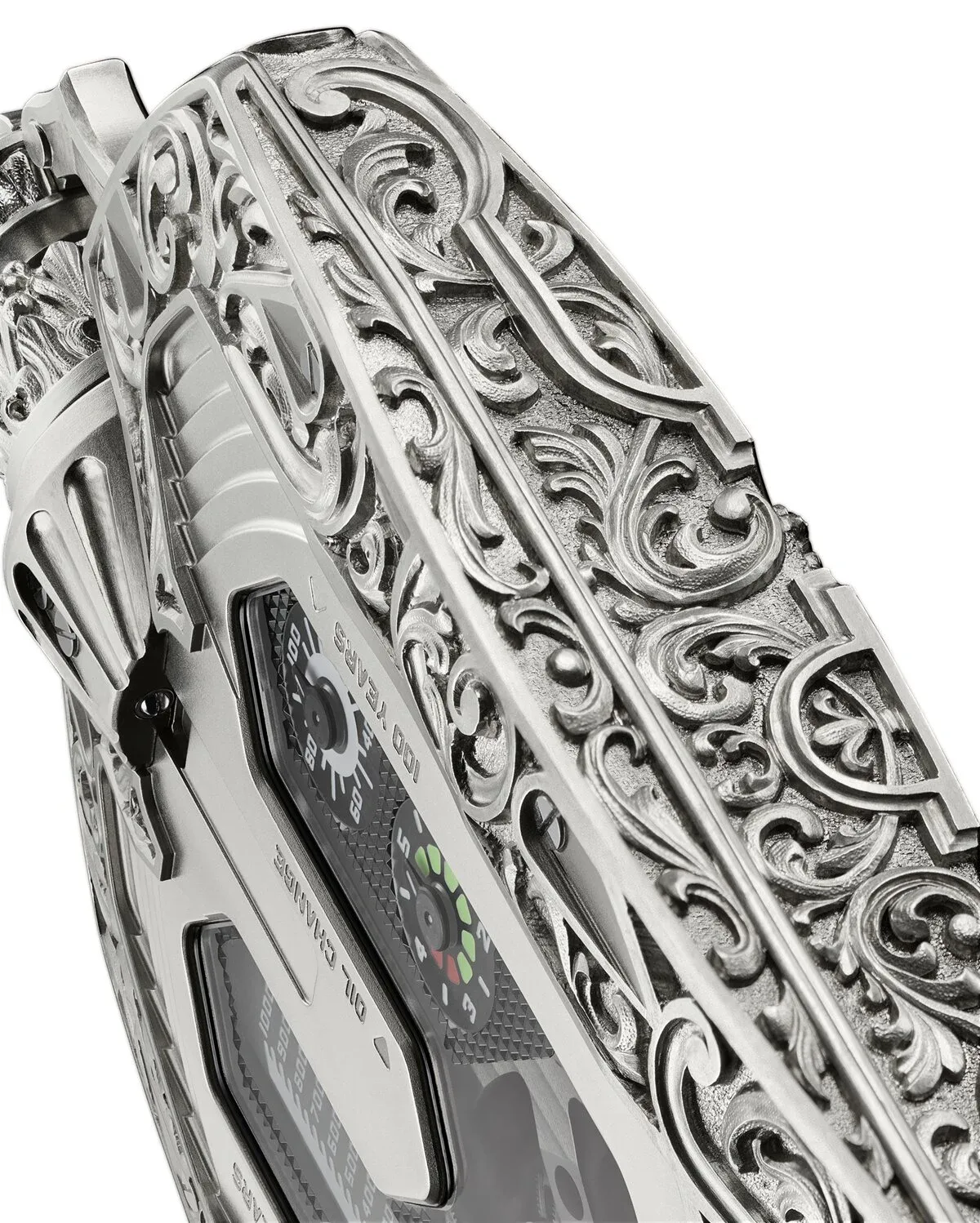
The reverse side takes the concept considerably further. An “Oil Change” indicator tracks the recommended service interval over five years, remaining white during the first three years before turning red during the fourth and fifth years to signal that maintenance is recommended. Once the watch has been serviced, the cycle can be reset.
Beyond that practical indication, the caseback introduces a 100 year time counter and a linear indicator capable of tracking 1,000 years. The first counter advances in five year increments, functioning almost like a mechanical odometer for the life of the watch. After a century has passed, it sends a pulse to the millennium counter, beginning a journey that moves so slowly the human eye can barely perceive its progress.
That millennium indication captures the central philosophy of the UR 1001 Amadeus. While a conventional seconds hand constantly emphasizes the present, the millennium display almost disappears into the background, forcing the wearer to think about time on a scale far beyond an individual lifetime. It transforms the pocket watch from a device that simply measures time into an object that encourages reflection on how humans experience duration.
The mechanical heart of the watch is the URWERK calibre UR 10.01, a highly complex movement containing 51 jewels and operating at 28,800 vibrations per hour, or 4 Hz. A single mainspring barrel delivers a 39 hour power reserve, while a unidirectional rotor provides winding. The movement uses a Swiss lever escapement, monometallic balance and flat balance spring, together with a co axial double star featuring an aluminum ring and platinum counterweight and a shock absorbing safety system.
The calendar mechanism uses a 93 tooth wheel and three Maltese crosses, while the retrograde minutes system relies on a 6.5 turn coil measuring 174.4 mm by 0.1 mm by 0.3 mm. The unusually long coil is engineered to provide a flatter torque curve. The movement’s main plates and bridges are made from ARCAP, while anti oxidant titanium screws, frosted plates, Côtes de Genève decoration, DLC treatments, chamfered surfaces and polished screw heads contribute to the extensive finishing.
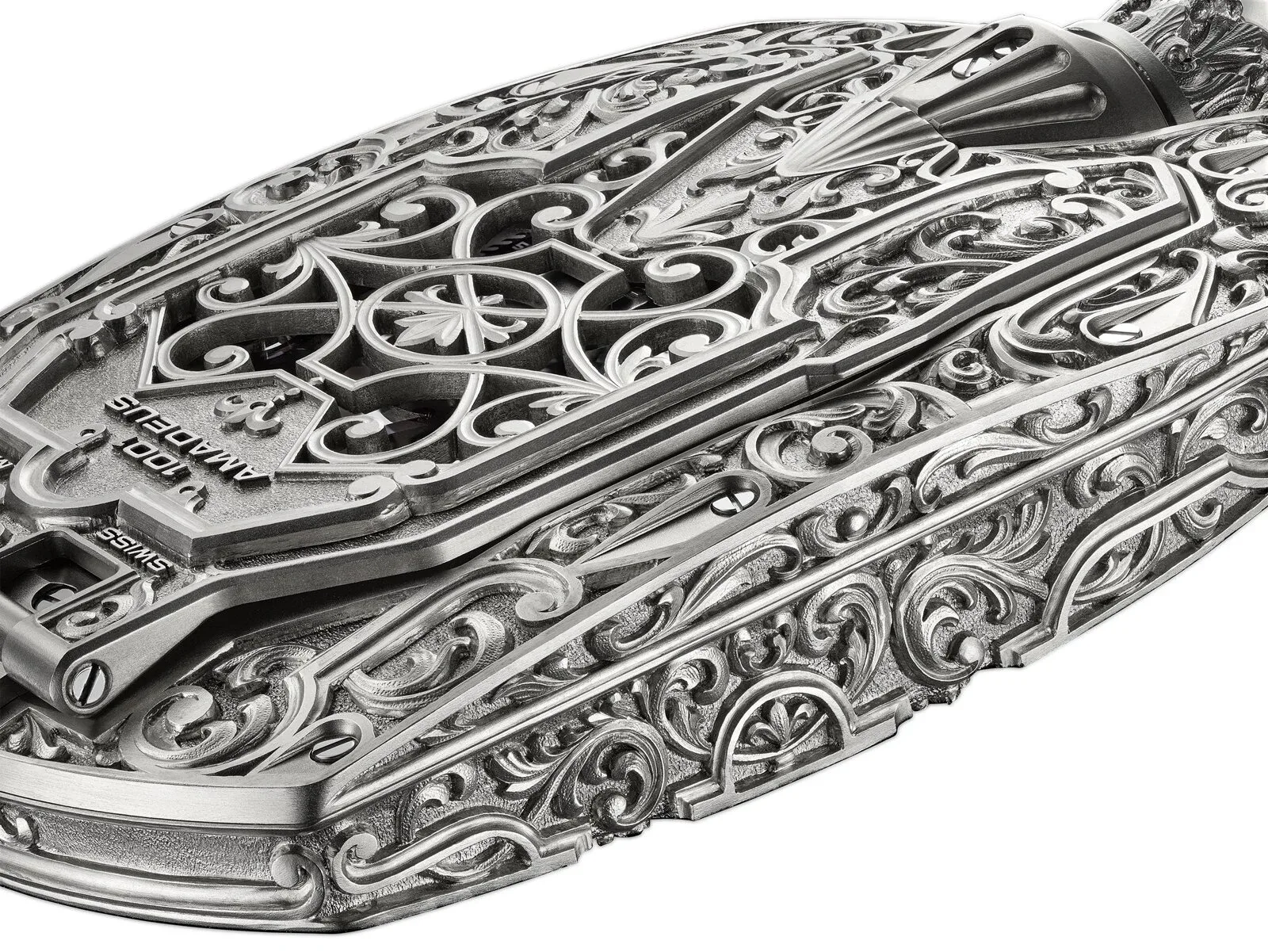
The physical presence of the Amadeus is equally unconventional. Its hand engraved titanium case measures 106 mm by 62 mm by 23 mm, making it considerably larger than a traditional wristwatch and giving it the scale required to house its extensive mechanical architecture. Glare proofed sapphire crystals protect the displays, while the case is tested to 3 ATM water resistance.
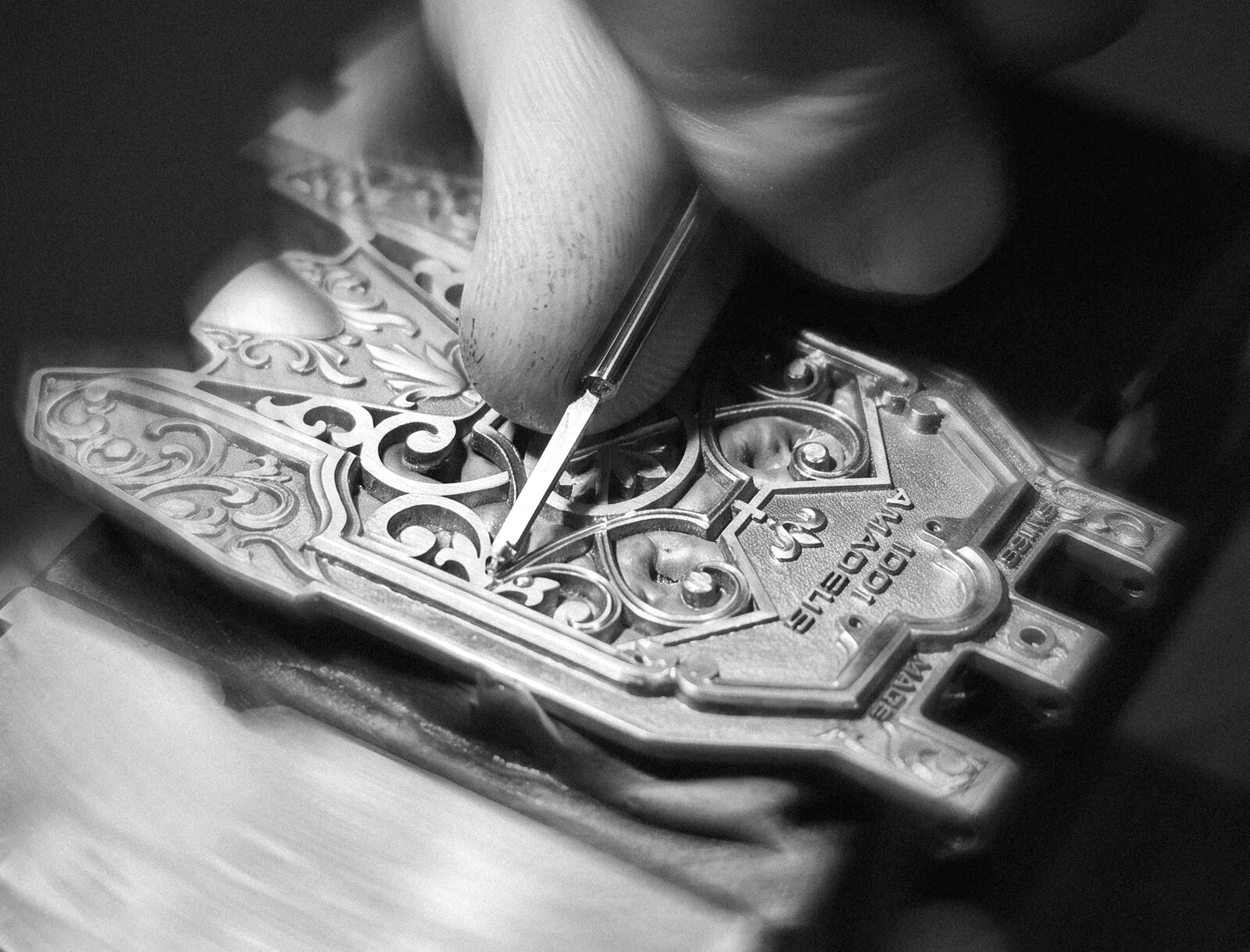
The exterior is where the mechanical creation becomes a genuine work of art. URWERK entrusted German engraver Florian Güllert with transforming the raw titanium case into an elaborate Baroque inspired surface. The project required nearly three months and approximately 500 hours of work, including the design process, and involved a combination of laser preparation, pneumatic chiseling, filing and hand finishing.
Titanium presented a significant challenge, requiring Güllert to rough cut the material with a laser before beginning the detailed engraving. He then created reliefs directly within the metal, using contrasting thick and thin strokes, textured backgrounds, dotted surfaces, satin brushing and matte finishes to manipulate the interaction between light and shadow. Each edge was refined and every detail carefully balanced until the engraving appeared to become part of the titanium itself rather than simply an applied decoration.
The name Amadeus reflects that extravagant personality. URWERK co founder Felix Baumgartner has linked the nickname to Wolfgang Amadeus Mozart, whose innovative and unconventional creative spirit provides an appropriate reference for a watch that refuses to follow traditional horological conventions. The contrast between Baroque inspired engraving and futuristic mechanical architecture gives the piece a character that is both historic and distinctly contemporary.
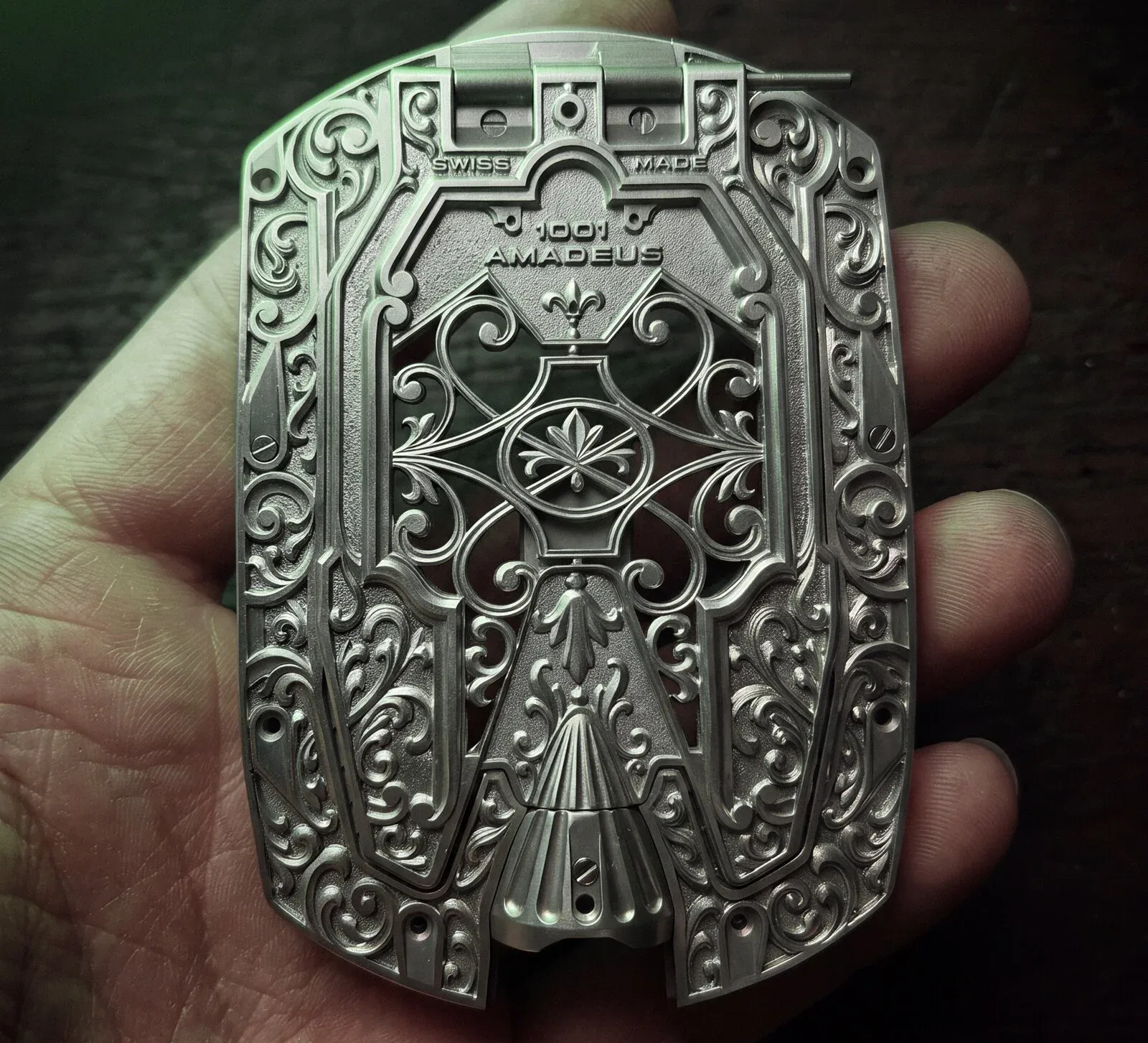
For collectors, the URWERK UR 1001 Amadeus specifications tell only part of the story. The watch combines a 51 jewel UR 10.01 movement, 4 Hz operating frequency, 39 hour power reserve, Swiss lever escapement and unidirectional winding rotor with satellite hours, retrograde minutes, an annual calendar, day and night indication, seconds and power reserve displays. Its reverse side adds the five year service indicator, 100 year counter and 1,000 year linear time display, while the titanium case measures 106 mm by 62 mm by 23 mm and incorporates sapphire crystals with 3 ATM water resistance.
The result is a one of a kind timepiece that feels less like an object designed to measure time and more like an object designed to make us contemplate it. Seconds disappear almost instantly, years accumulate gradually, centuries belong to generations and a millennium is almost impossible to comprehend. URWERK has brought all of those scales together in one extraordinary titanium creation, leaving the eventual owner not merely with a luxury watch, but with a mechanical reminder that every moment is part of something much larger.
Timely FAQs
What makes the URWERK UR 1001 Amadeus so unusual?
How does the UR 1001 Amadeus display a millennium?
What makes the UR 1001 Amadeus case special?
What are the key technical specifications of the URWERK UR 1001 Amadeus?
