If you ever get the chance to attend an Omega collectors’ meetup, I highly recommend it.
Four new designs with improved Co-Axial movements and slimmed cases announced the new chapter of the Omega Speedmaster.
I love that Omega fans are rarely ostentatious. Some wax lyrical about how the Speedmaster’s history is intertwined with NASA’s accomplishments, or how the Seamaster serves as the personal envoy of Agent 007. Others revere the manufacture’s relentless pursuit of accuracy—embodied by breakthroughs like the industrialization of George Daniels’ Co-Axial escapement and the Spirate adjustment system.
Some diehards memorize the chronology and evolution of the brand’s offerings, and often scour for a particular historical reference distinguished by a subtle detail the uninitiated might overlook. Yet one common thread binds most of the brand’s followers: they love a stately, traditional-looking tool watch.
With releases like 2024’s Speedmaster Pilot and 2025’s Speedmaster Moonphase Meteorite, however, it’s apparent that Omega has been testing its followers’ appetite for evocative machinations.
This past week, Omega dropped four too-cool-for-school designs—three of which come with two strap options, for a total of seven new references that hint at where the brand is headed.
Omega now seems intent on crafting less traditional, more wearable watches—creations that, true to the brand’s spirit of craftsmanship, their owners will never grow tired of admiring.
Last month, Taylor entered her Showgirl era. Now, we’re entering Omega’s new era of slimmer, yet technically and aesthetically unassailable statement pieces, where there’s something for everyone.

Come to the Dark Side
Omega’s relationship with space first began when Walter Schirra chose to wear his personal Speedmaster (first released in 1957, notably with a black dial) aboard his journey to space in 1962. However, the Speedmaster’s Dark Side of the Moon lore would only begin in 1968 when all the astronauts aboard the Apollo 8 wore Speedmasters to orbit the Moon. A pivotal moment in the Speedmaster’s history came in 2013, when the Speedmaster “Dark Side of the Moon” reimagined the icon in black zirconium oxide.
Since then, the “DSotM” saga has been defined by blacked-out color palettes, advanced ceramic construction, and thematic expansions that include the Grey Side, White Side, and Blue Side of the Moon.
The novelties Omega just unveiled feature slimmer, improved versions of the acclaimed Co-Axial Master Chronometer movements, reaffirming the brand’s dedication to precision and performance.
Arriving in the ever-popular 44.25mm case size, these seven references showcase ceramic cases that are meticulously beveled and polished, complemented by Omega’s signature ceramic bezels. Their two-layer ceramic dials offer the kind of visual depth that has become synonymous with the brand’s dial architecture.

Seven New References Across Four Dial Designs
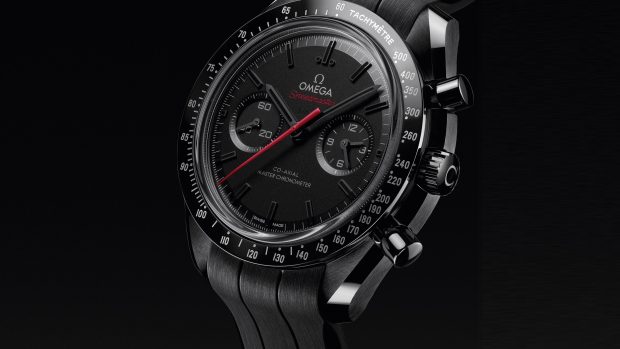
Differentiated by its red seconds hand and ‘Speedmaster’ signature, the Omega Dark Side of the Moon Black Edition is powered by the Caliber 9908, which is based on the Speedmaster Caliber 9300 and boasting a 60-hour power reserve. It only comes on a black rubber strap with a ceramic foldover clasp.
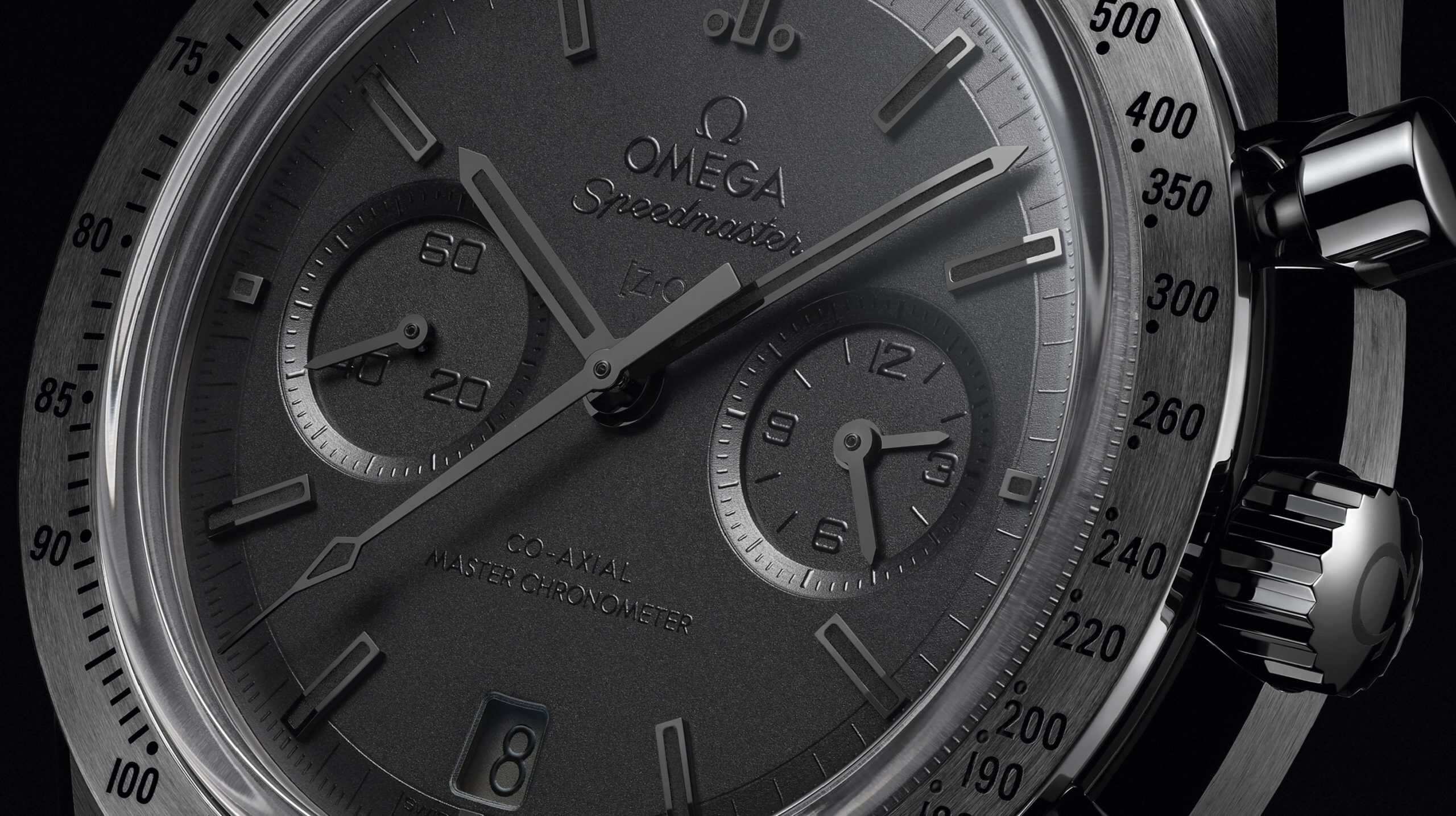
The Caliber 9908 also powers the Omega Dark Side of the Moon All-Black Edition, which uses a refined interplay of shiny and matte surfaces to achieve legibility. This blackout timepiece—even its Super-LumiNova is black—evokes designs like the F.P. Journe Furtif and Yohji Yamamoto’s Hublot GMT. It’s available on a black rubber strap or a black nylon fabric strap now lined with rubber for greater comfort.

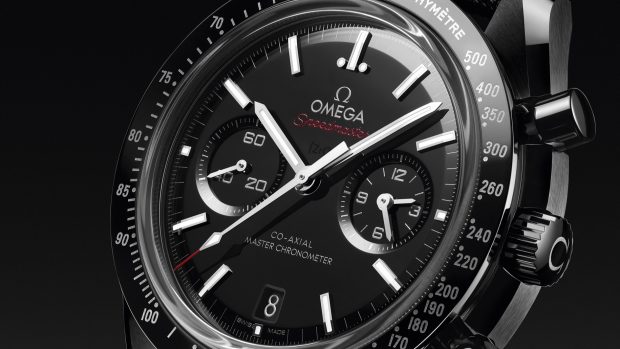
Thirdly, the Omega Dark Side of the Moon with white accents is powered by the Caliber 9900 (also with 60 hours of autonomy), another descendant of the legendary 9300. This model, too, has fabric and rubber strap variants.

Finally, inspired by Jim Lovell’s famous quip, “The Moon is essentially gray,” uttered during the Apollo 8 mission, the Omega Grey Side of the Moon Edition serves as the sequel to last year’s black-and-yellow DSotM. Its skeletonized aluminum dial is stunning, while its multilayer caseback offers a captivating view into the Caliber 3869 movement (with 50-hour power reserve). While the novelties above feature casebacks with Geneva waves in arabesque, the 3869’s architecture draws the eye much like a Lange. Furthermore, the plates on its openworked dial are laser-etched to resemble the near side of the Moon, while those on the caseback imitate the far side’s rugged texture.

While the aforementioned DSotM models have been slimmed to around 15mm in thickness, the Grey Side of the Moon is even leaner at about 13mm. These timepieces are priced from USD 15,700 for the DSotM with white accents to USD 16,400 for the Grey Side of the Moon.