The MB&F LM101 has always been a watch about essentials—a suspended balance, hours and minutes, and a power-reserve indicator—so it is a little surprising to find a jungle growing around them. For its latest Performance Art collaboration, MB&F has teamed up with independent artist and enameler Gabriel Colliard to turn the LM101 into three miniature cloisonné landscapes, each produced in an edition of eight pieces.
MB&F and enameler Gabriel Colliard created three LM101 editions with cloisonné enamel jungle scenes—Macaw in red, Monkey in blue, and Crocodile in green—each limited to eight pieces in a 40mm platinum case with an upgraded 60-hour manual-winding movement.

Each edition is built around a single animal and a dominant color. In Macaw – Red, a pair of scarlet macaws takes flight between jungle and sea in reds and oranges. Monkey – Blue places a mischievous monkey among fruit and vegetation beside a lake of rippling water, rendered in many shades of blue. Crocodile – Green shows the reptile with its jaws open at the edge of a swamp, surrounded by layered greens. The palettes are not strictly monochrome; touches of other colors punctuate each scene.

The idea started with the richly colored cloisonné enamel dials of the 1950s and their depictions of the natural world. Colliard’s instinct as a painter was to work with a broad palette, and his early proposals followed that more traditional route until the MB&F team suggested building each composition around one hue. He reworked the drawings, drawing on Post-Impressionism and vintage Symbolist imagery for a stylized look rather than an elaborate Baroque one.

MB&F says the project grew out of a wish to support Colliard as an independent artist and give his work wider recognition, and it gave him a freedom rarely offered in commissions: rather than executing a predefined design, he developed his own compositions. His path to the bench was indirect. After studying fine arts in Argentina, he moved to Switzerland in 2003 and found his way into watchmaking through polishing. By 2008 he had turned to enameling, training in Limoges, France, and working in specialist workshops and for companies such as Patek Philippe before establishing his own independent practice.

Cloisonné takes its name from the cloisons, the tiny compartments formed by extremely fine gold wires that Colliard bends by hand to trace each animal, leaf, and ripple. He fills them with finely ground enamel, fires the piece in a kiln, assesses the result, and repeats, building color and depth layer by layer while the gold outlines stay visible in the finished image. He works with translucent, semi-opaque, and opaque enamels, and a single-hue palette raises the stakes: neighboring tones must be close enough to harmonize yet distinct enough for the animals to read.
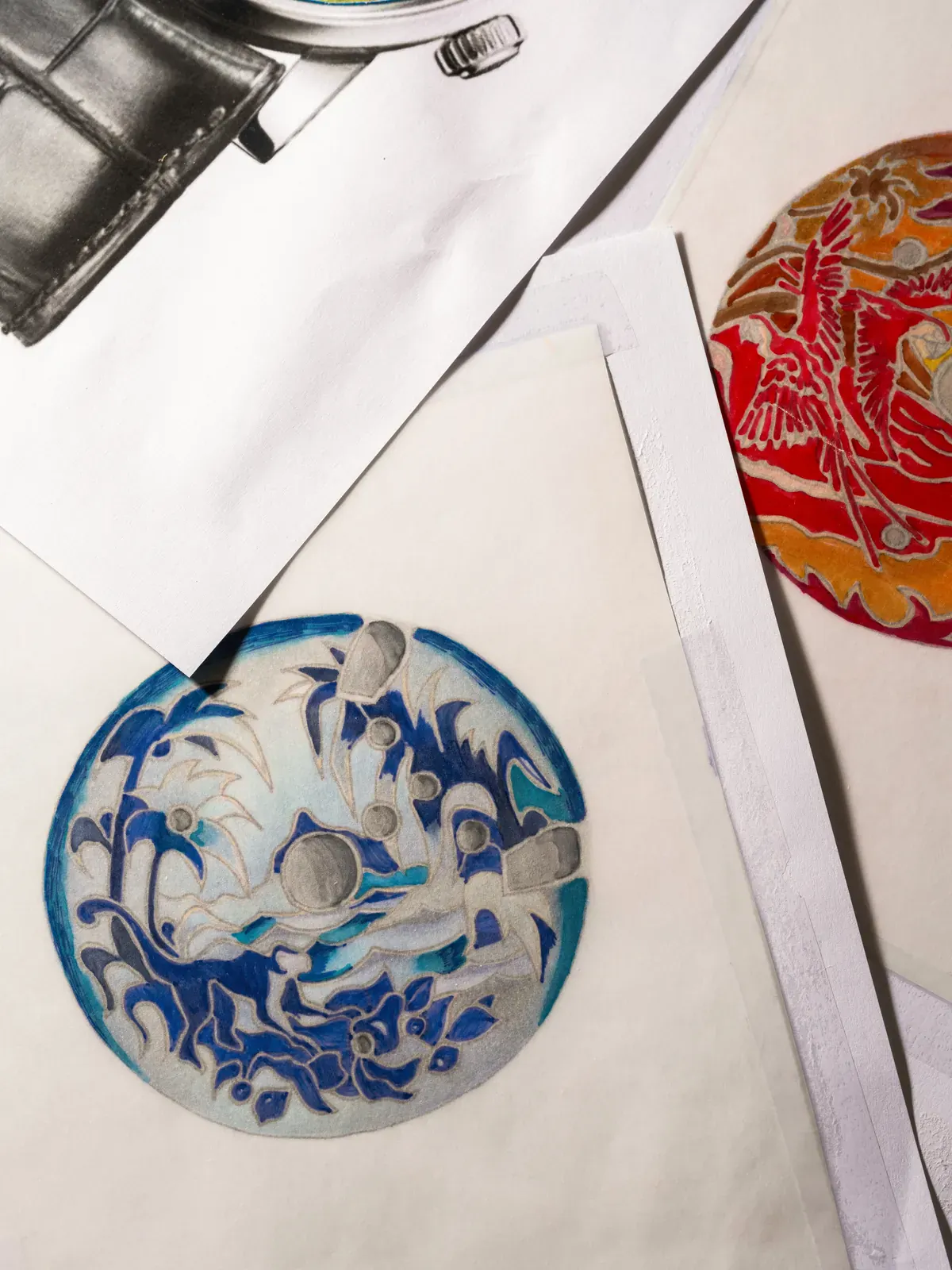
Enamel also changes in the kiln, so a shade can emerge differently than it went in, and correcting it can mean removing material and firing again, with every firing able to affect work already done. Even within an edition, no two of the eight examples will be entirely identical. Colliard expects to complete roughly one enamel composition per month, and MB&F anticipates more than two years to finish all 24 watches. As Colliard likes to say, the fire always has the final say.
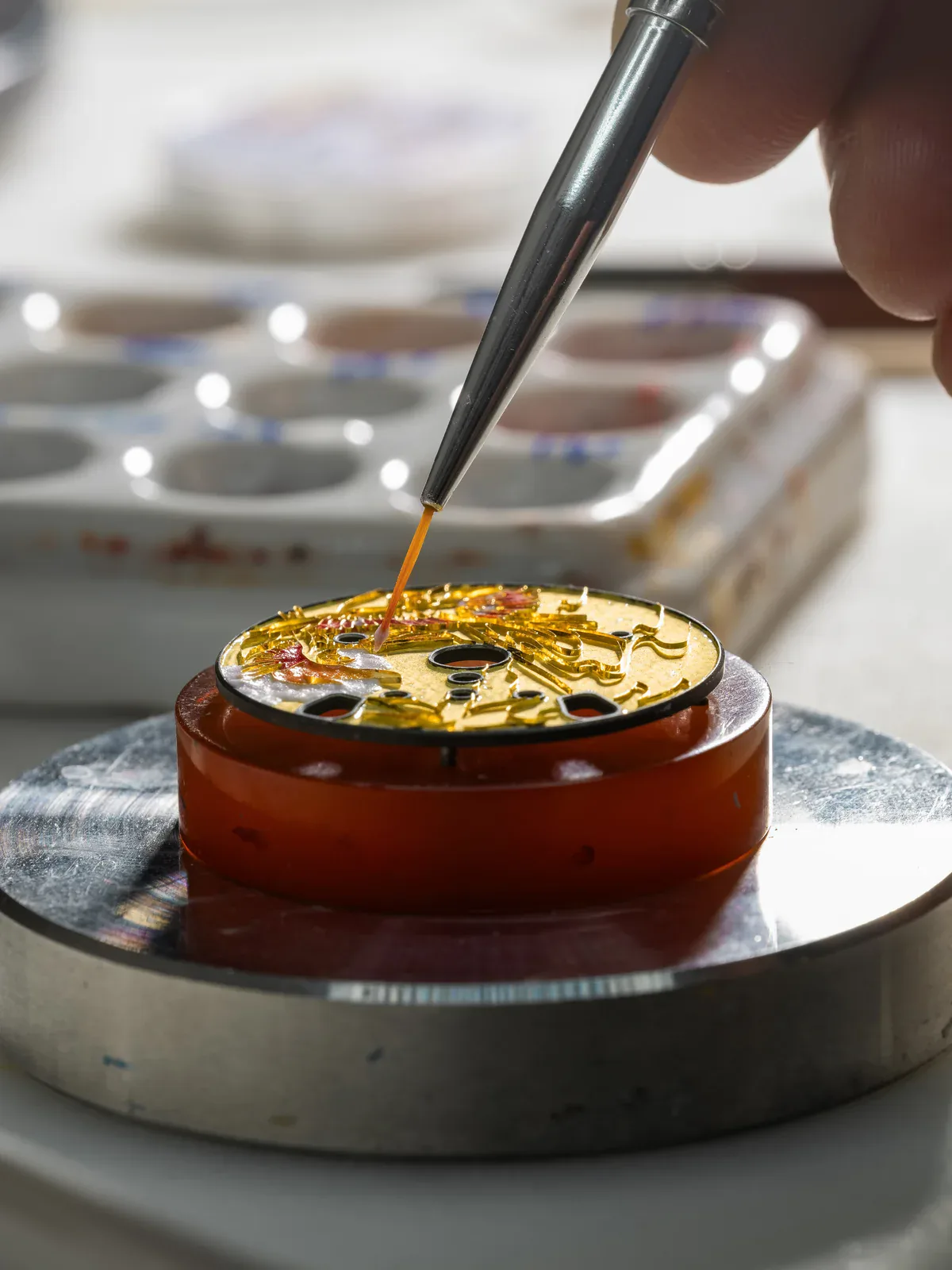
The LM101 is not an easy canvas. Its large suspended balance rises above the movement, sculptural bridges sweep across the surface, hours and minutes sit at 2 o’clock, and the power reserve sits at 6. Vegetation had to find room around the bridges and the animals had to stay recognizable beneath them. To accommodate the thickness of the enamel, MB&F modified the dial plate—the movement’s minute bridge—removed the sub-dials for the time and power reserve, and extended the hands. Colliard’s work continues on the reverse, where an enameled ratchet wheel echoes the colors and jungle motifs of the front.

Launched in 2014, the LM101 was the first movement conceived entirely by MB&F’s in-house engineering team, developed with independent watchmaker Kari Voutilainen, who set its finishing specifications. For these editions the manually wound caliber has been upgraded: its 222 components now deliver 60 hours of power reserve, up from 45 hours on earlier LM101s, and the 14mm balance, beating at 18,000 vibrations per hour, gains a Straumann double hairspring. Through the sapphire caseback, Geneva waves, hand-polished bevels, gold chatons, and countersunk blued screws are on view.

The LM101 has worn platinum before, as with the Legacy Machine 101 in platinum of 2016. Here the case is 40mm platinum, 16.55mm high and water-resistant to 30 meters, fitted with an alligator strap and a stainless-steel folding buckle with a white gold cover. With eight pieces per edition and a pace set by the kiln, the MB&F LM101 Gabriel Colliard editions will arrive slowly, one jungle at a time.
| Specification | Detail |
|---|---|
| Model | LM101 Gabriel Colliard |
| Editions | Monkey – Blue, Macaw – Red, Crocodile – Green; limited to 8 pieces each |
| Dial | Cloisonné enamel minute bridge (dial plate) and ratchet wheel by Gabriel Colliard |
| Movement | Three-dimensional manual-winding movement developed in-house by MB&F with Kari Voutilainen |
| Power reserve | 60 hours, sliding bridle barrel |
| Balance | 14mm, Straumann double hairspring |
| Frequency | 18,000 vph (2.5 Hz) |
| Components | 222 |
| Jewels | 23 |
| Finishing | NAC-treated rear bridges; rhodium-plated mainplate |
| Functions | Hours and minutes at 2 o’clock; power-reserve indicator at 6 o’clock; central balance; crown at 4 o’clock |
| Case | Platinum; 40mm diameter; 16.55mm high; 35 components |
| Crystals | Sapphire with anti-reflective coating on both sides |
| Water resistance | 30 meters |
| Lug width | 21mm |
| Strap | Alligator with stainless-steel folding buckle with white gold cover; buckle width 20mm |
| Price | Not published |
Timely FAQs
What is the MB&F LM101 Gabriel Colliard?
How many LM101 Gabriel Colliard watches will be made?
What movement does the LM101 Gabriel Colliard use?
