The perpetual calendar has always carried a quiet contradiction at its center. It is a complication designed to relieve the wearer of any need for intervention — tracking leap years, short months, and every irregularity of the Gregorian calendar through 2100 without a single manual correction. And yet, leave it unworn long enough and the whole mechanism stops, requiring the kind of careful reset that rather defeats the point. Vacheron Constantin has spent years working on this problem. With the updated Traditionnelle Twin Beat Perpetual Calendar, they have taken it as close to solved as mechanical watchmaking currently allows.
Vacheron Constantin updates the Traditionnelle Twin Beat Perpetual Calendar, extending its standby power reserve to 70 days.

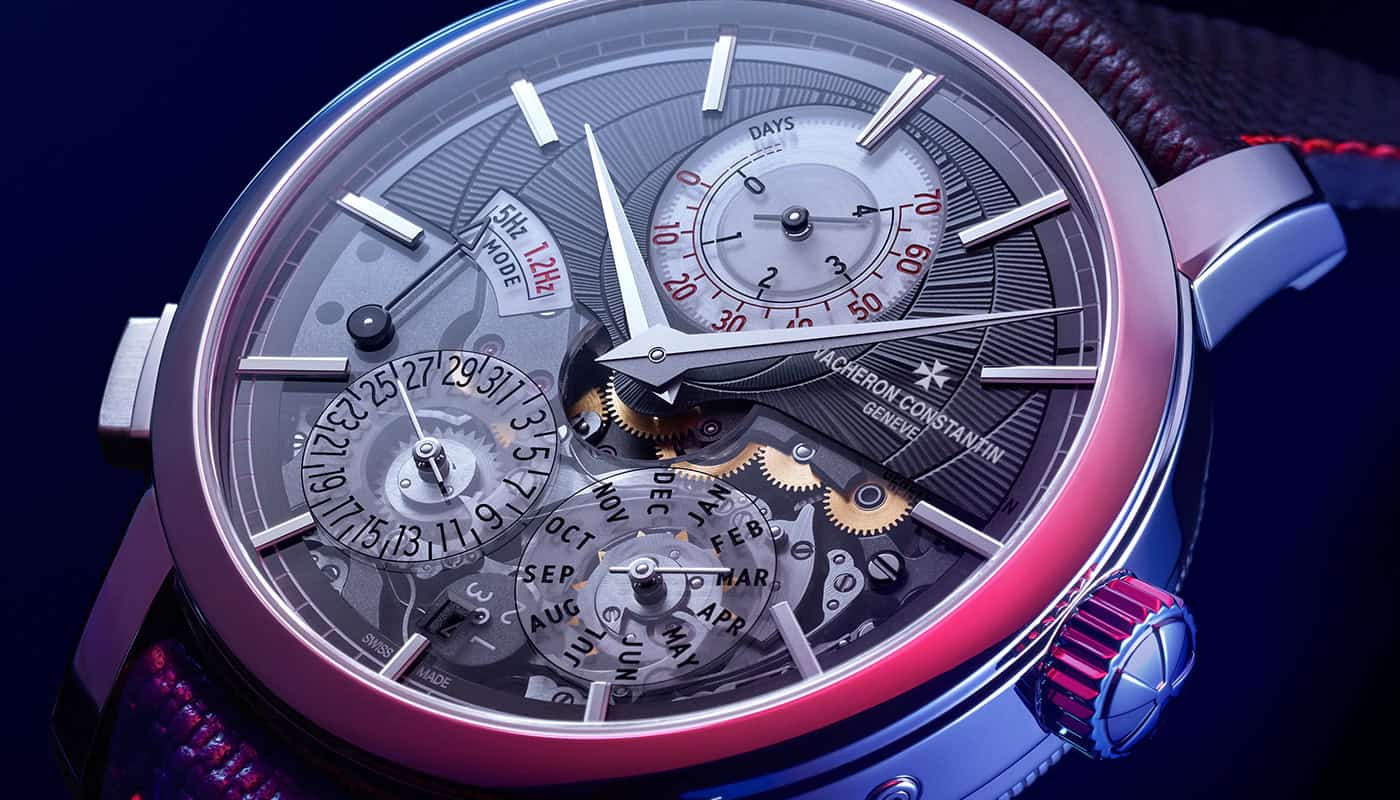
First unveiled in 2019 as a limited concept piece, the Twin Beat returns in 2026 as a refined production watch — reference 3200T/000P-H167 — powered by an optimized version of the hand-wound Caliber 3610 QP. The movement’s core innovation remains its patented dual-frequency Twin Beat system: two independent gear trains sharing a coaxial double barrel, one operating at 5 Hz (36,000 vibrations per hour) for precision in Active mode, the other running at a low 1.2 Hz (8,640 vph) during Standby. The result is a perpetual calendar that offers a four-day power reserve when worn and an extraordinary 70 days when set aside — a five-day improvement over the original, earned through a painstaking optimization of the caliber’s three differentials and a new double-gear spring-winding mechanism that requires four times less torque than conventional instant-jump systems.

That last detail matters more than it might initially suggest. Instantaneous jumping perpetual calendar displays — where the date changes in a single snap rather than a gradual crawl — are notoriously energy-intensive, typically affecting the amplitude of the balance wheel and introducing imprecision at the moment of transition. Vacheron Constantin’s engineers addressed this directly, developing a winding system that makes the date change dramatically less demanding on the movement’s energy chain, and refining the 1.2 Hz system to sustain constant amplitude throughout the full standby duration.

Switching between modes is handled by a push-button at 8 o’clock, which stops one balance wheel and starts the other instantaneously, maintaining all time and calendar displays throughout the transition without interruption. A mode indicator hand on the dial confirms which frequency is active at any given moment — a considered detail that reflects how thoroughly this watch has been designed from the wearer’s perspective.
Christian Selmoni, Vacheron Constantin’s Director of Style and Heritage, put it plainly: “In recent years, as it has become a matter of prime importance to address users’ concerns about issues relating to the power reserve of mechanical watches, it was a natural step for us to undertake further development of Calibre 3610 QP.” The movement — 480 components, 64 jewels, just 6 mm thick at 32 mm in diameter — carries the Geneva Seal, certification that speaks as much to the standard of finishing as it does to technical performance.
The case is 42 mm in platinum 950, measuring 12.3 mm in thickness — slim for a watch of this mechanical density. The dial is where the 2026 version makes its most visible statement. A two-part sapphire construction, it pairs a lower section that reveals the sandblasted, NAC-treated mainplate with an upper 18K gold plate finished in slate grey and hand-guilloché with a radiating pattern. White gold Dauphine hands carry the hours and minutes; the power reserve and frequency mode hands are in 18K yellow gold with black PVD treatment, laser-etched frosted glass giving the counters a frosted legibility that reads cleanly against the movement below. The reverse is equally considered — hand-beveled bridges finished with Côtes de Genève, the anthracite grey of fixed components set against the golden yellow of the moving parts. The strap is black textured calfskin with hand-stitched red thread lining and a 950 platinum pin buckle.
There are watches that make a case for mechanical horology on aesthetic grounds alone. The Traditionnelle Twin Beat Perpetual Calendar makes a different argument — that the craft still has genuine technical problems left to solve, and that solving them with this level of elegance is itself a kind of art.
