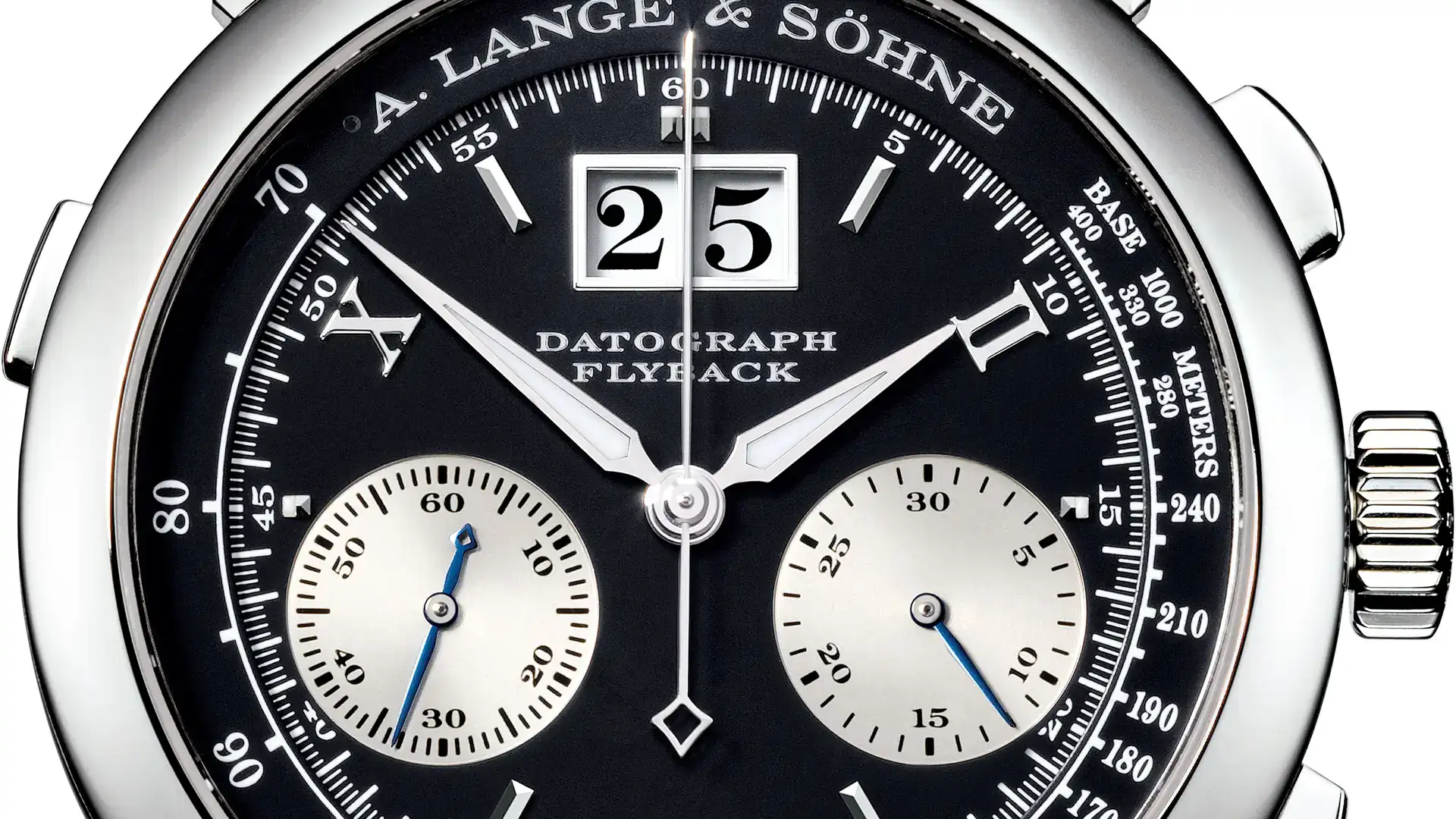
When A. Lange & Söhne put a chronograph on a Basel fair stand in 1999, the manufacture was five years into its first wristwatch collection, launched in 1994. The watch was the Datograph, and it was the first A. Lange & Söhne chronograph after the brand’s renaissance in 1990. Developed under Günter Blümlein and powered by the newly designed, manually wound caliber L951.1, it arrived with a flyback function, a classic column wheel, a precisely jumping minute counter, and the outsize date that has since become a Lange signature.
A. Lange & Söhne introduced its first in-house chronograph, the Datograph, in 1999. Later models include the Double Split of 2004, the Triple Split of 2018, the 1815 Chronograph, and the Odysseus Chronograph of 2023, the manufacture’s first automatic chronograph.
In our view, that first Datograph still explains the house’s approach. Lange says that instead of adapting a basic caliber for each later model, every A. Lange & Söhne chronograph is given a dedicated movement made for that design.
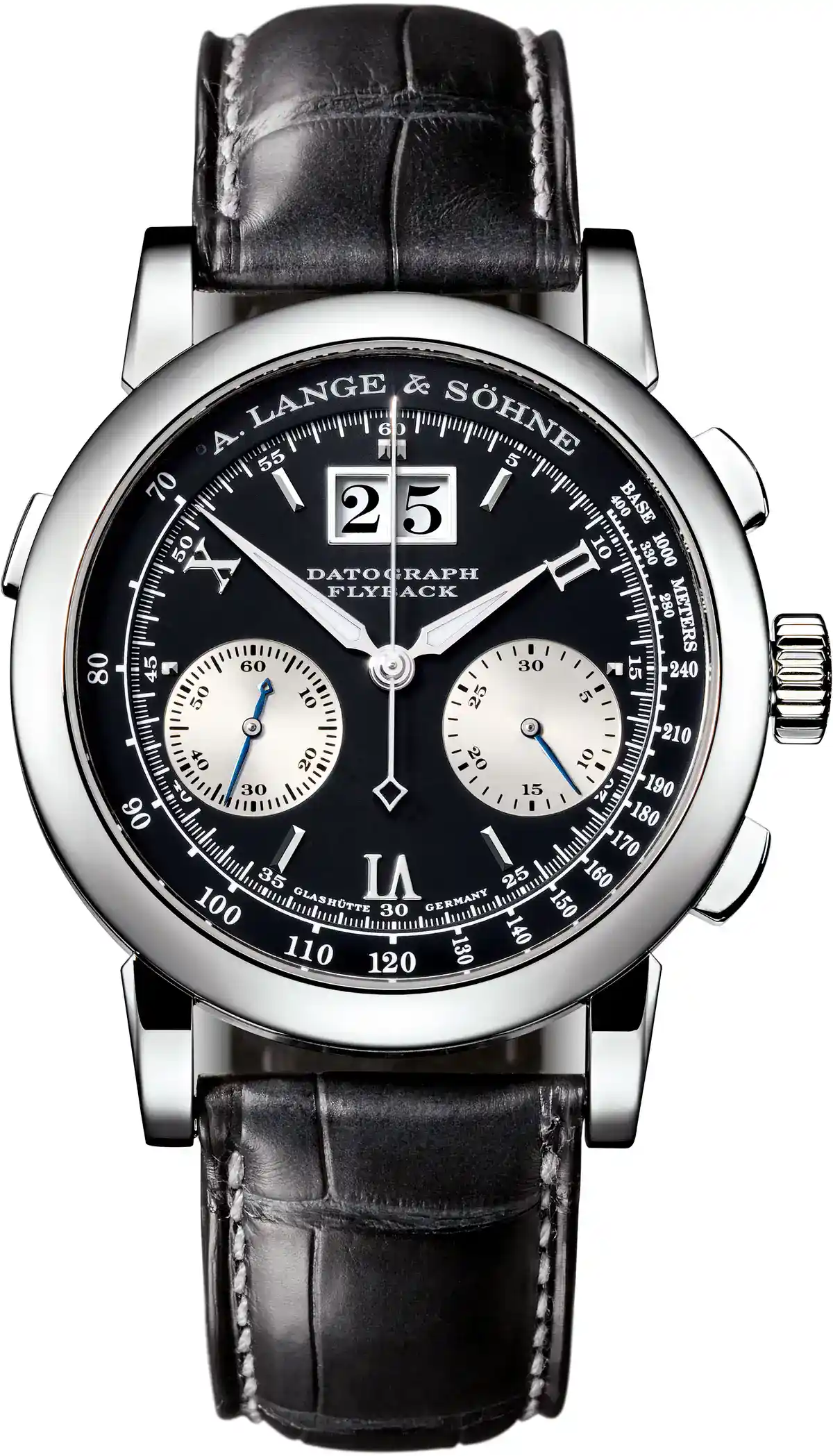
The Datograph, 1999
Lange presented the Datograph at the Basel tradeshow shortly before the new millennium, under the auspices of Blümlein, with Walter Lange beside him. The manufacture describes caliber L951.1 as consisting of 405 parts, assembled twice and finished in the house’s customary way. On the dial, the outsize date at 12 o’clock forms the tip of an equilateral triangle with the two light-colored subsidiary registers, the small seconds at 9 and the jumping minute counter at 3, both set slightly below the center line against a black dial.
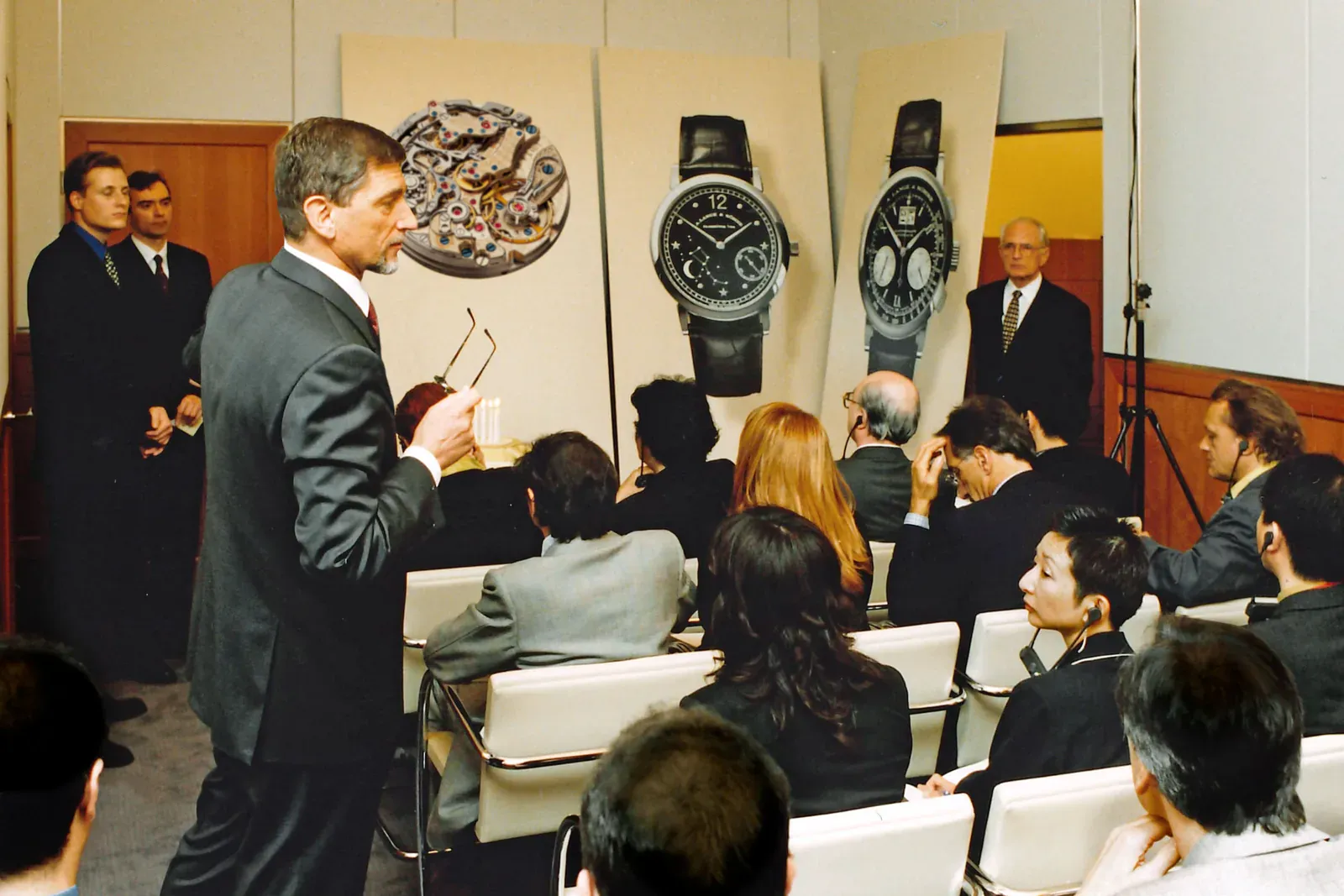
That arrangement, Lange says, was an expression of Blümlein’s brief: “From the beginning, it was important for us to create watches whose sleek, classic appearance is an expression of supreme modernity.” Anthony de Haas, Director of Product Development, has called the Datograph, even 25 years after its debut, “a reference for a consummate chronograph.”
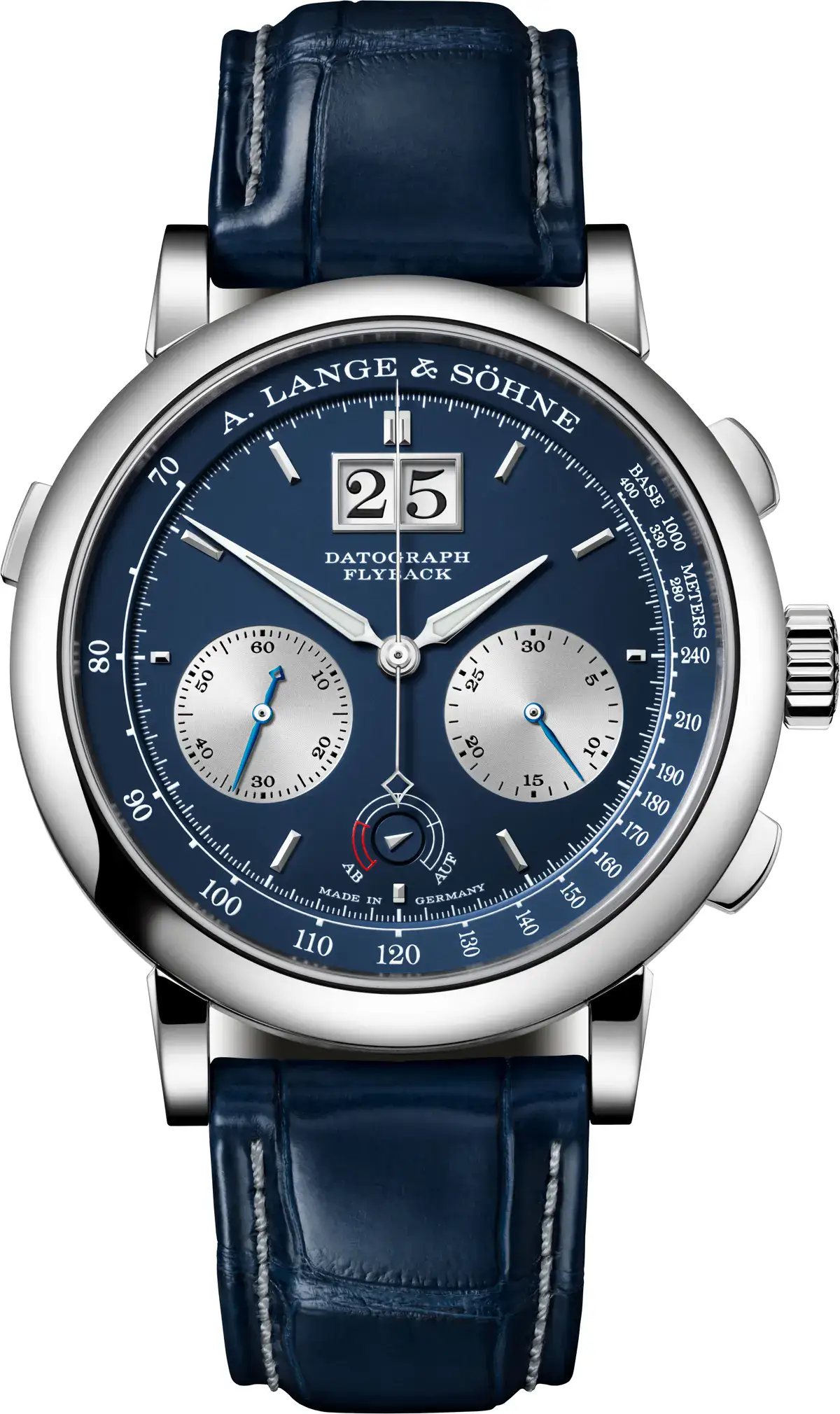
The family did not stop in 1999. In 2006, Lange introduced the Datograph Perpetual, combining a flyback chronograph with a perpetual calendar and an outsize date. Our look at the Datograph Perpetual in platinum takes that later chapter up to the present. In 2012, the Datograph Up/Down raised the power reserve to 60 hours, added a power-reserve indicator at 6 o’clock, and introduced an oscillation system developed in-house. At Watches and Wonders 2024, Lange issued the Up/Down in a third version, a white-gold case with a blue dial, limited to 125 pieces, and presented the Datograph Perpetual Tourbillon Honeygold “Lumen.”
Double Split and Triple Split
If the Datograph set the modern-classic template, the rattrapante watches opened a different line of work. A classic split-seconds hand can be stopped independently of the chronograph seconds and then resynchronized with it, which, Lange notes, allows comparative measurements of up to 60 seconds. In 2004, the Double Split became, in the manufacture’s words, the first chronograph equipped with a double rattrapante in the history of precision watchmaking. A second minute counter extended the range of intermediate measurements from 60 seconds to 30 minutes.
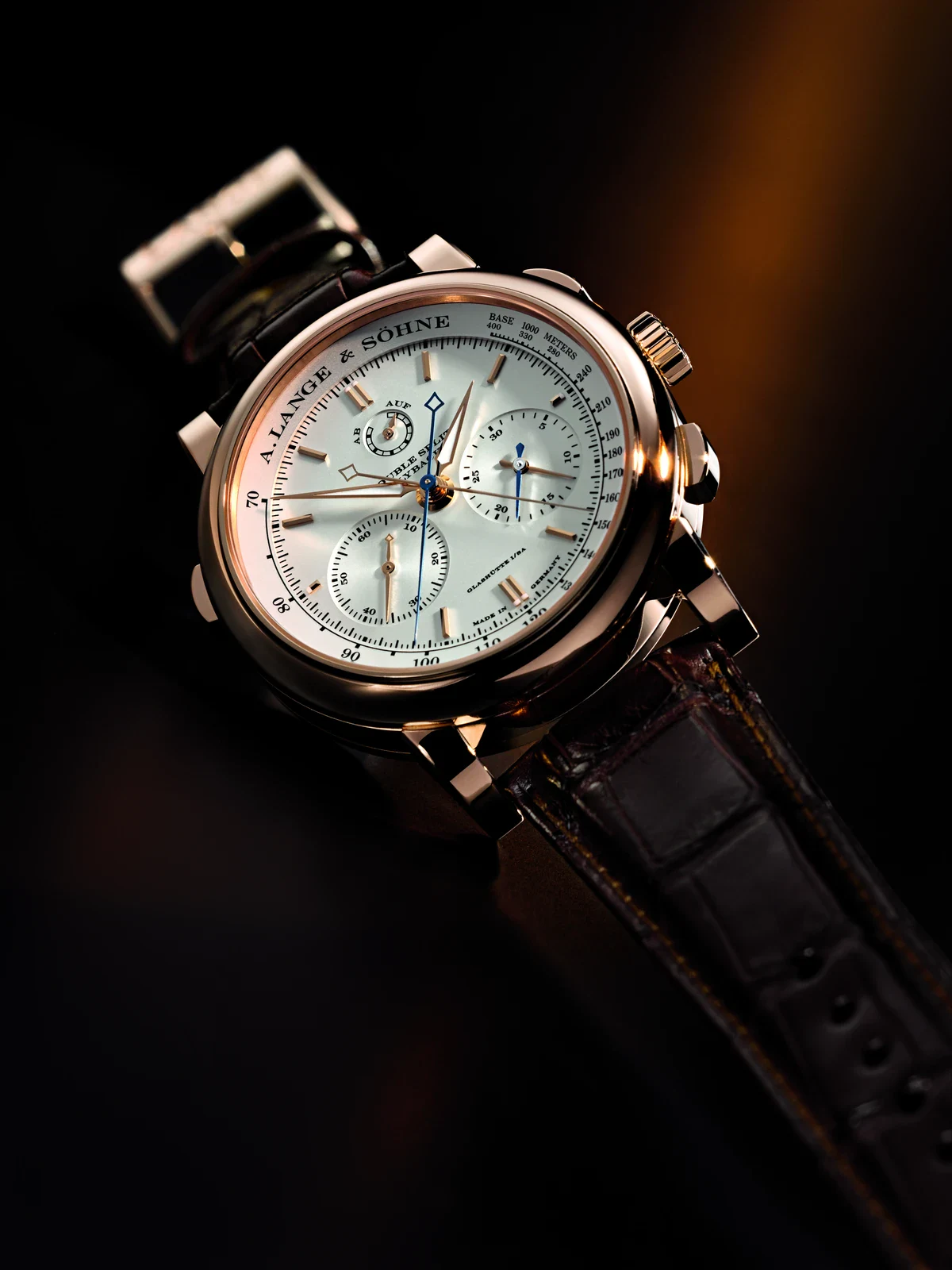
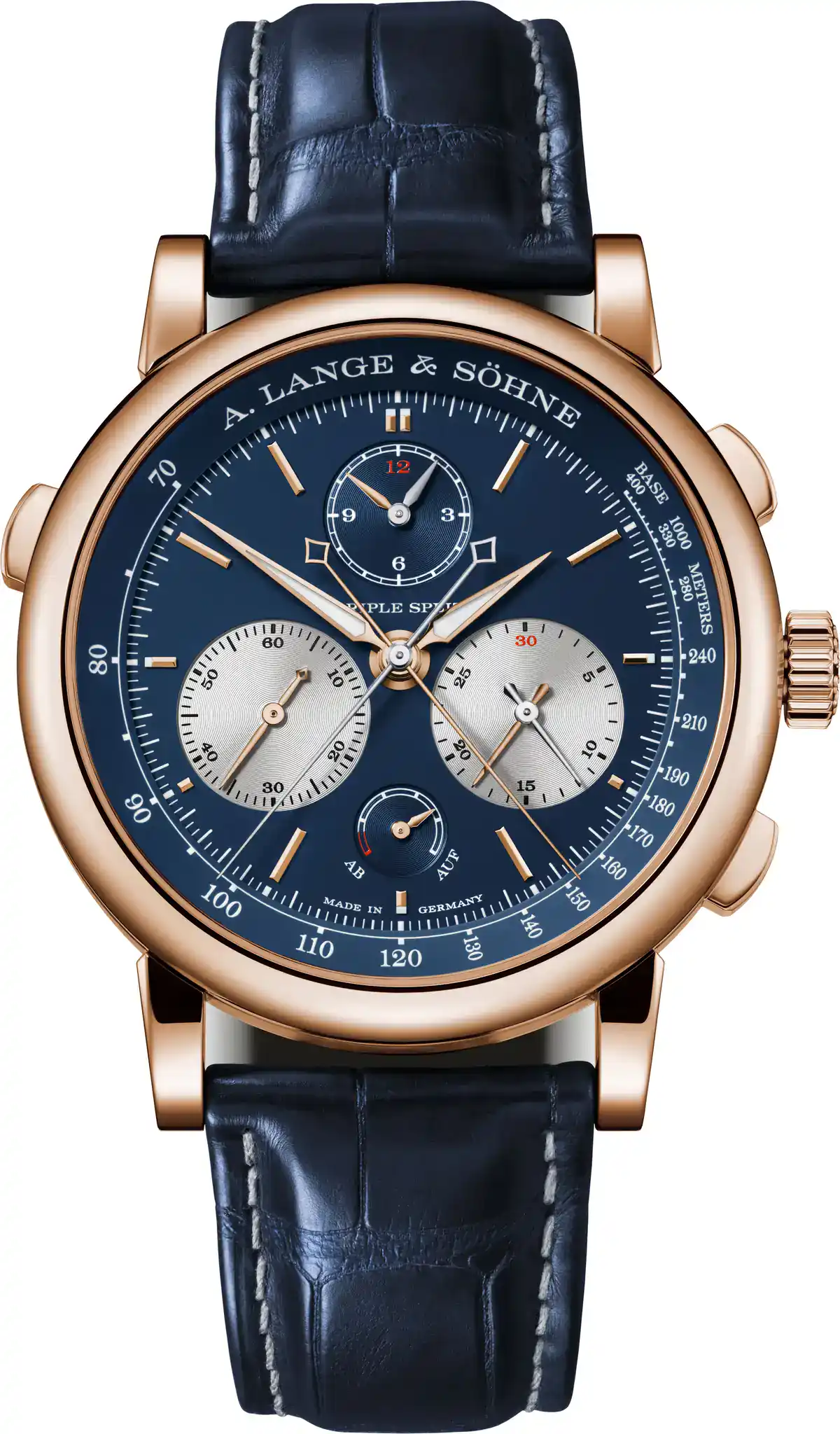
The Triple Split, which made its debut in 2018, added a third pair of hands. With that addition, Lange says, intermediate measurements can be extended to a maximum of 12 hours. In its 2024 retrospective, the manufacture still described both the Double Split and the Triple Split as unique in precision watchmaking.
The 1815 Chronograph
The 1815 Chronograph was added to the 1815 family in 2004. It follows the same design principle as the Datograph, Lange says, but without the outsize date: a railway-track minute scale and two subsidiary dials, the small seconds at left and the 30-minute counter at right, set slightly below the center line. In 2010, the model received a new movement, caliber L951.5, with a 60-hour power reserve and a free-sprung balance spring made in-house. Because it beats at 18,000 semi-oscillations per hour, or 2.5 hertz, the watch can measure times to one-fifth of a second. It retains the jumping minute counter and adds a flyback function, so a running measurement can be reset to zero and started again with a single pusher.
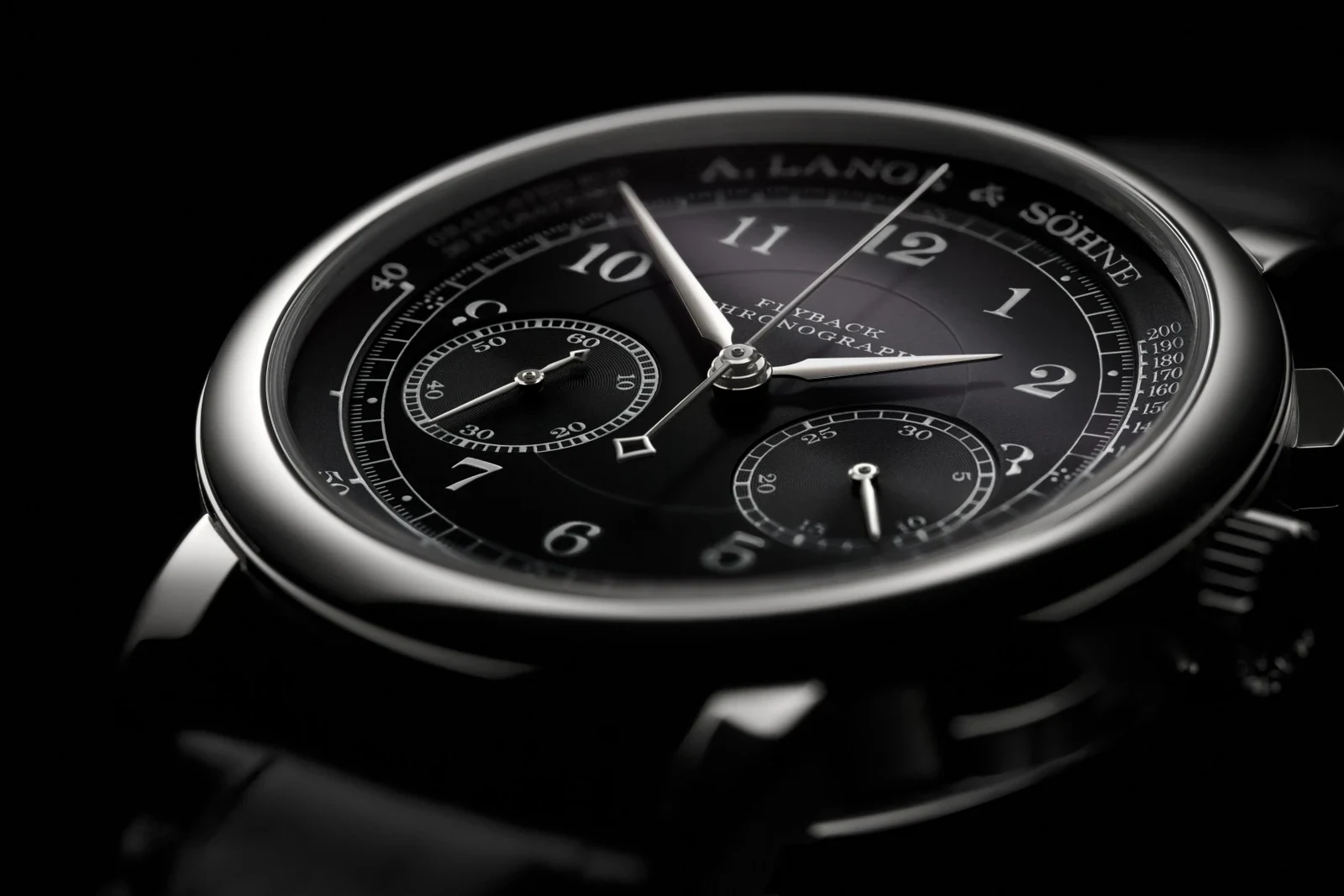
Some versions, including the 2017 white-gold model, carry a pulsimeter scale on the outer ring of the dial. Lange also uses a more traditional split-seconds layout in the 1815 Rattrapante, and in watches such as the Tourbograph Perpetual “Pour le Mérite.” A fourth approach appears in the Grand Complication of 2013, whose chronograph is a mono-pusher, in what Lange calls a tribute to the beginnings of historic chronograph construction.
The Odysseus Chronograph
The Odysseus Chronograph, launched in 2023, is a different idea again. It is powered by caliber L156.1 Datomatic, which Lange describes as the manufacture’s first self-winding chronograph movement. To keep the Odysseus dial, with its outsize date and day of the week, the engineers placed both chronograph hands in the center: a minute counter with a lozenge-shaped tip and a red chronograph seconds hand. Lange gives the movement a frequency of 28,800 vibrations per hour, or 4 hertz, a power reserve of 50 hours when fully wound, and a measuring range of 60 minutes. The first Odysseus Chronograph was presented in a stainless-steel case and limited to 100 pieces.
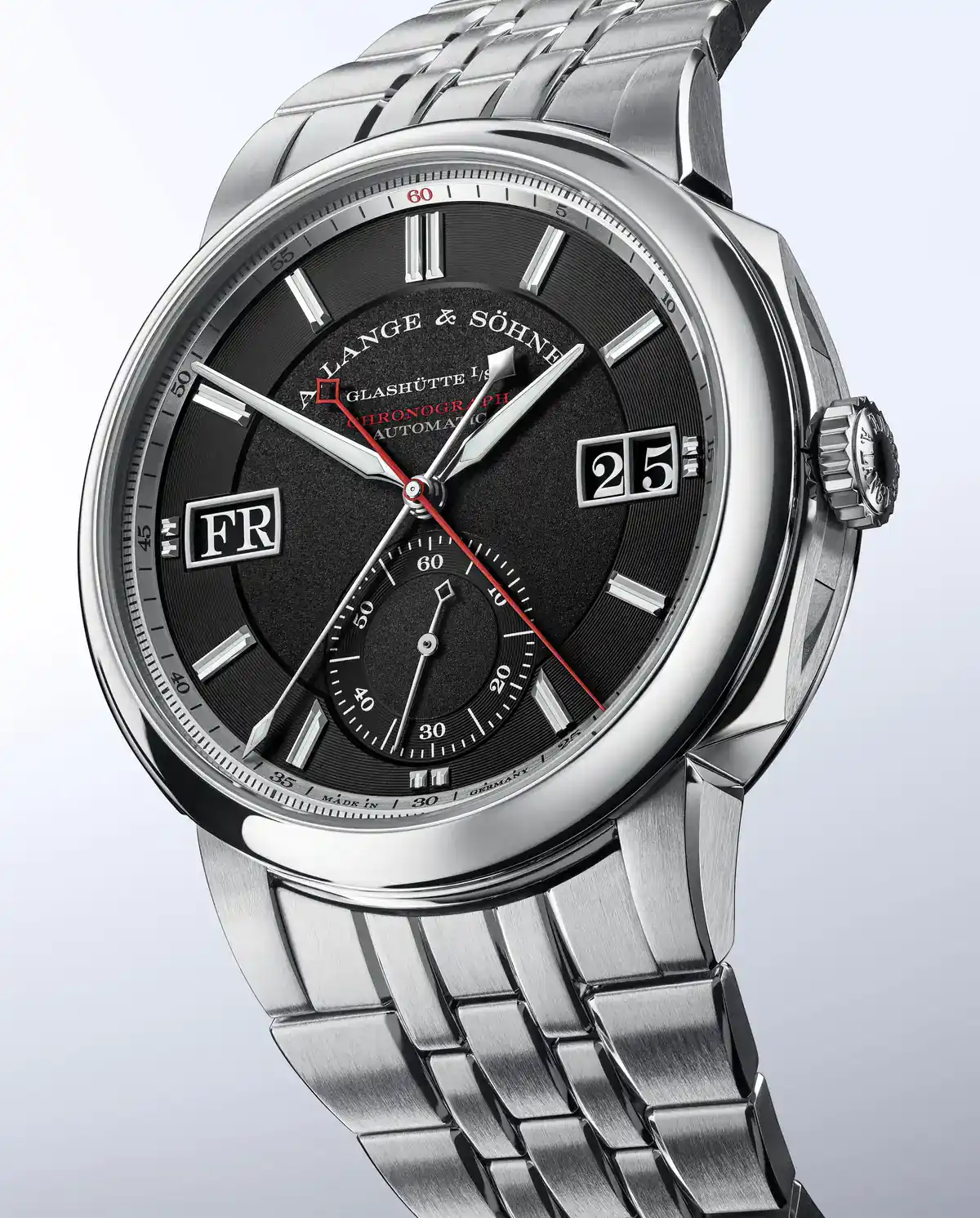
Its most distinctive gesture is the zero reset. Lange says that when the hands are sent home, the minute counter jumps back in the usual way, while the red chrono seconds hand covers the distance it has traveled, one full revolution for each measured minute, in a fraction of a second. The direction depends on whether the minute counter has passed 30. The wedge-shaped pushers do double duty: with the crown in its normal position they start, stop, and reset the chronograph; with the crown pulled to the first position, they correct the date and the day of the week.
The longer thread runs further back than 1999. Lange notes that Ferdinand Adolph Lange crafted his first chronograph in 1868, with a single pusher to start, stop, and reset the hand. By 2024, the manufacture said it had developed 13 chronograph models and 72 movements in-house. A. Lange & Söhne does not publish a single retail price for the family; current models are available on request at its boutiques. The through-line is not a shared caliber reused from one generation to the next, but a habit of starting over.
| Specification | Details |
|---|---|
| 1999 | Datograph, caliber L951.1, the first A. Lange & Söhne chronograph after the 1990 renaissance; flyback, column-wheel, jumping minute counter, outsize date; 405 parts, assembled twice |
| 2004 | Double Split, the first double rattrapante in the history of precision watchmaking, according to Lange; intermediate measurements extended from 60 seconds to 30 minutes |
| 2004 | 1815 Chronograph added to the 1815 family; in 2010, caliber L951.5, 60-hour power reserve, 18,000 semi-oscillations per hour (2.5 hertz), flyback, jumping minute counter |
| 2006 | Datograph Perpetual, a flyback chronograph with a perpetual calendar and outsize date |
| 2012 | Datograph Up/Down, 60-hour power reserve, power-reserve indicator at 6 o’clock, in-house oscillation system |
| 2013 | Grand Complication, with a mono-pusher split-seconds chronograph |
| 2018 | Triple Split, a third hand pair extending intermediate measurements to a maximum of 12 hours |
| 2023 | Odysseus Chronograph, caliber L156.1 Datomatic, Lange’s first self-winding chronograph; limited to 100 pieces in stainless steel; 28,800 vibrations per hour (4 hertz); 50-hour power reserve; 60-minute range |
| 2024 | Datograph Up/Down in white gold with a blue dial, limited to 125 pieces; Datograph Perpetual Tourbillon Honeygold “Lumen,” caliber L952.4, 684 parts, assembled twice |
| Price | On request, at A. Lange & Söhne boutiques |
Timely FAQs
When did A. Lange & Söhne introduce its first chronograph?
What is the difference between the Double Split and the Triple Split?
What is the Odysseus Chronograph?
